


BP continues to seek funding for 218 project
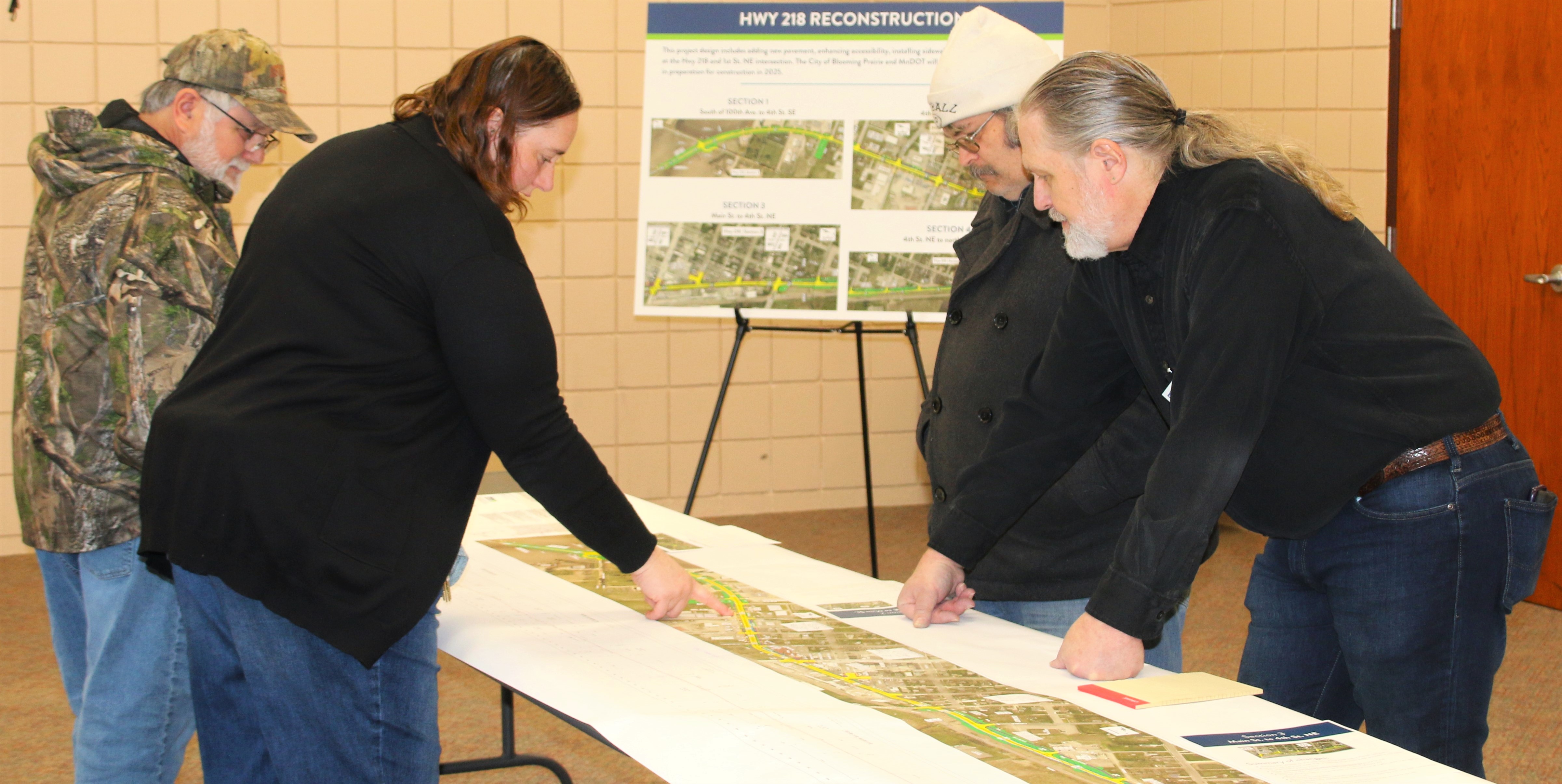
Residents of Blooming Prairie, from left, Stan Norland, Karen Peterson, and Kevin Mans, look at the project layout of the Hwy. 218 reconstruction through town. At right is Mark Trogstad-Isaacson, project manager. The work remains on MnDOT’s 2025 schedule, even as the city seeks funding to help pay for soil contamination remediation. Staff photo by Kay Fate
The reconstruction of U.S. Highway 218 through Blooming Prairie is full of twist and turns, said a Minnesota Department of Transportation spokeswoman – but she wasn’t talking about the road.
Cindy Morgan, MnDOT public engagement coordinator, and Mark Trogstad-Isaacson, the project manager, hosted an open house last week to share the final design with community members and provide an update on the project’s timing.
It’s not a long stretch of road – about two miles from just south of Steele County Road 36 to just past the north leg of U.S. Highway 30 – but the $9.5 million price tag will include a lot of work.
The project has been in the works for at least five years, said Morgan, and is a partnership between MnDOT and Blooming Prairie, allowing the city to replace aging water and sewer lines that run under the highway while the ground is open.
“Our portion to pay for is the road,” Morgan said of the state. Anything beyond the roadwork falls to other agencies – in this case, the city.
Should the city have decided not to do the utility work during the project, “10 years from now, if the city wants to replace the lines, they’d have to cover the expense” of tearing up – and rebuilding – a relatively new road, she said.
The work was scheduled for 2024, but the first major twist came last spring, when MnDOT needed to purchase a right-of-way from a private property along the route.
There was a problem: The property had a high risk of environmental contamination and required an environmental review to proceed. The review added about a year to the schedule for an investigation of contaminated soil and/or groundwater and to determine best management practices for construction.
There was no way to complete the project without the property at issue, and the project was delayed from 2024 to 2025.
The contamination investigation revealed more bad news: Contamination of soils and groundwater had migrated into the Hwy. 218 corridor, Brett Grabau told members of the Blooming Prairie City Council in June.
An engineer with Stantec, Grabau has worked on Blooming Prairie projects for nearly 20 years.
“It’s the responsibility of MnDOT, the city, and the utilities to remove and dispose of any contaminated soils and groundwater they encounter as part of the project,” Grabau said in June – and it must be paid for before the work starts.
The city was prepared to cover its share of the reconstruction project, about $1.4 million.
The environmental issues, however, are an unexpected – and unbudgeted – expense.
In addition to remediating and containing the contamination, the city must now use ductile iron pipes instead of standard PVC piping, and more enforced seals at the joints. Those things will double – if not triple – the cost of the entire project, said Melanie Aeschliman, city administrator.
The level of contamination “was pretty shocking,” she said. “I can’t speak for my predecessors, but I do not feel that we, as a city, were aware of the extent. The (Minnesota Pollution Control Agency) has a list of contaminated sites, and Blooming Prairie was not on that spreadsheet.
“We’ve definitely been very vocal about our concerns with the city taking on this (financial) obligation,” Aeschliman said.
Grabau and city officials have met with legislative leaders to ask for state funding; a bill supporting that request may be drafted in the next session.
Sen. Gene Dornink and Rep. Patricia Mueller have been advocating for the city.
The MPCA was “definitely receptive” to Blooming Prairie’s concerns about the contamination and its financial burden, Grabau said, but “at this time, the MPCA doesn’t have any avenue available to financially assist in the remediation to lessen the burden on the city.”
MnDOT is expected to put the project out for public bid in October 2024, with anticipated award in December 2024.
Though that timeline means Blooming Prairie must dedicate and transfer its payment by November 2024, MnDOT is offering some flexibility by “continuing to commit resources to the project without knowing if the city is going to be in a position to financially move forward,” Grabau said.
Meanwhile, Aeschliman isn’t giving up on finding another source of funding and is grateful for MnDOT’s accommodation.
“If we cannot get the funding, they may take that money and move it to another project,” she said. “Then we’re left with not only an unrepaired road, but 75-year-old pipes – and increased costs” when the project makes it back on the schedule.