


Drug Court graduates travel different paths
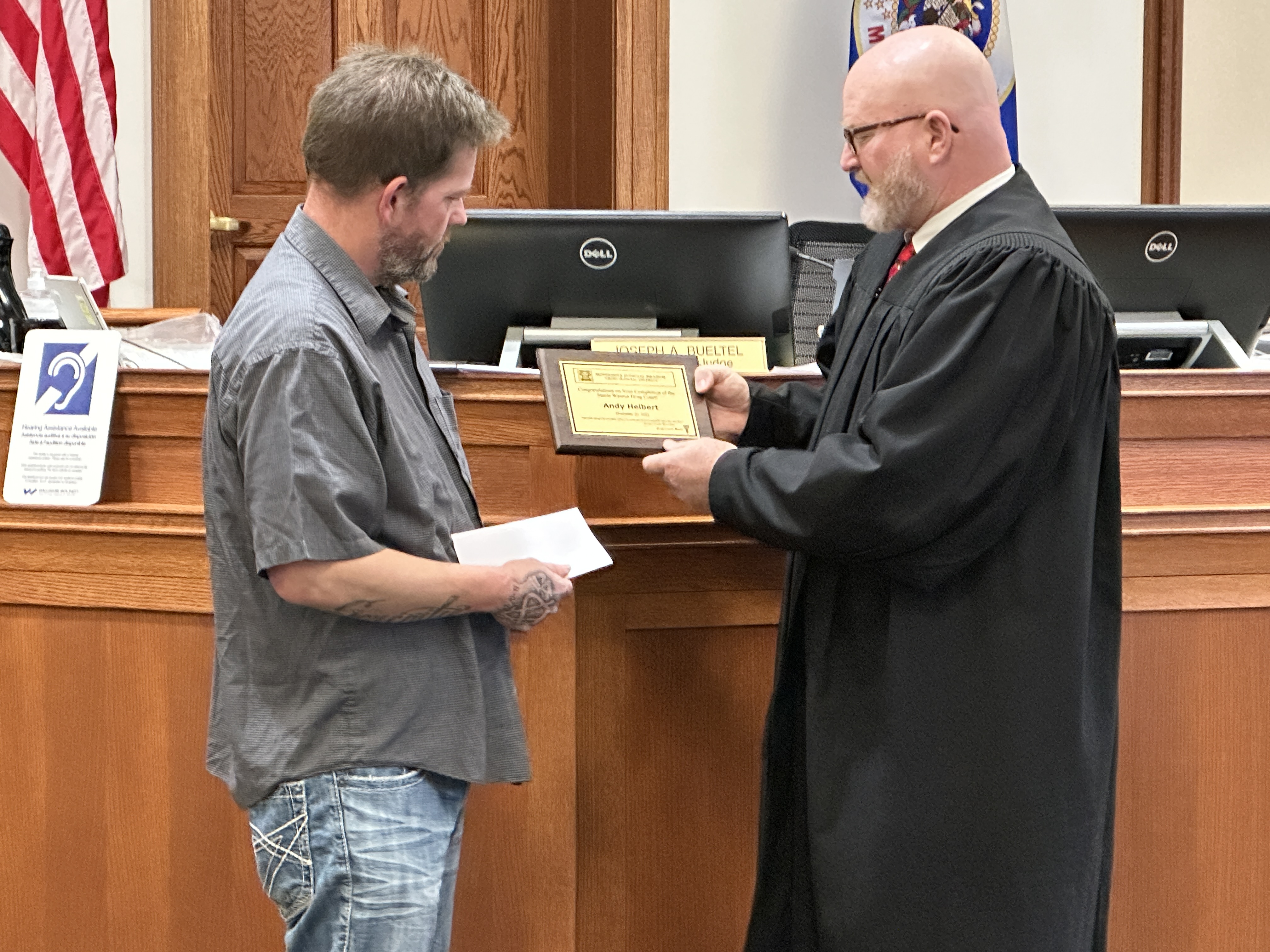
Steele-Waseca Drug Court graduate Andy Hiebert, left, listens as Third District Court Chief Judge Joseph Bueltel reads the plaque marking his accomplishment. After three years of work, Hiebert graduated from the program last week. Staff photo by Joni Hubred
Andy Hiebert traveled a rocky path through Steele-Waseca Drug Court, but on Dec. 20, his hard work–completed over a period of three years–paid off.
Hiebert and a second graduate, who asked that his name be withheld, are the 98th and 99th graduates of the combined court, which will celebrate its 10-year anniversary in July of 2024. They were honored during a Dec. 20 ceremony held at the Steele County courthouse.
Coordinator Nicole Grams said planning for the program began in 2013, as officials looked for a way to “keep folks from cycling in and out of our courts.” Drug court provides an alternative to incarceration, with participants opting instead to address chemical dependency, mental health issues, and facing other challenges like keeping a stable home, holding down a job, and completing their education.
Addiction, Grams said, “was the primary driver for getting them into trouble.”
Participants start with an assessment of their mental health and housing needs, then start working on stability and mental health treatment.
The program works in phases; initially, people are checking their phones first thing in the morning to learn whether they need to show up for drug testing. The curfew starts at 9:30 p.m. and gradually phases out. Appointments with a probation officer start weekly, then move to monthly.
“In the final phase,” Grams said, “we’re really working on establishing a recovery community.”
Of the more than 200 participants, about half have graduated. The other half ended up serving out their original terms of incarceration or got into more trouble.
Hiebert is a success story despite “lots of struggles” within the program, Grams said. He started the program facing felony level drug and DWI charges. Now, he has nearly a year of sobriety under his belt, a good job, and a community of people who keep him on the right track.
During the ceremony, conducted by Third Judicial District Court Chief Judge Joseph A. Bueltel, Hiebert thanked the Drug Court staff for believing in him “when I didn’t believe in myself.”
“In the beginning, I had issues with trust,” he said. “As I started to trust the process, I started to see growth in myself.”
One year earlier, Hiebert said, he left in-patient treatment and told himself he would “trust the process even when things were difficult to do.”
“I’m very happy with my life today, and the path I’m on,” he said.
The other participant said while Drug Court took a long time, “it was worth every struggle for me.” He participated in the program for two years and two months, after being arrested on a felony DWI charge and facing 42 months in prison.
Just before his arrest, he said, he’d been drinking with co-workers, who tried to talk him out of driving. Someone who saw him driving “all over the road” called the police.
“I am glad someone reported me,” he said. “Who knows what would have happened if I had kept going.”
Drug Court, he said, “gave me an opportunity to face my responsibilities out here, instead of behind bars.”
While both men took very different journeys, Bueltel said to them, both “came here looking to make things better in your life, and you have.”