


Drug grad finds value in helping others
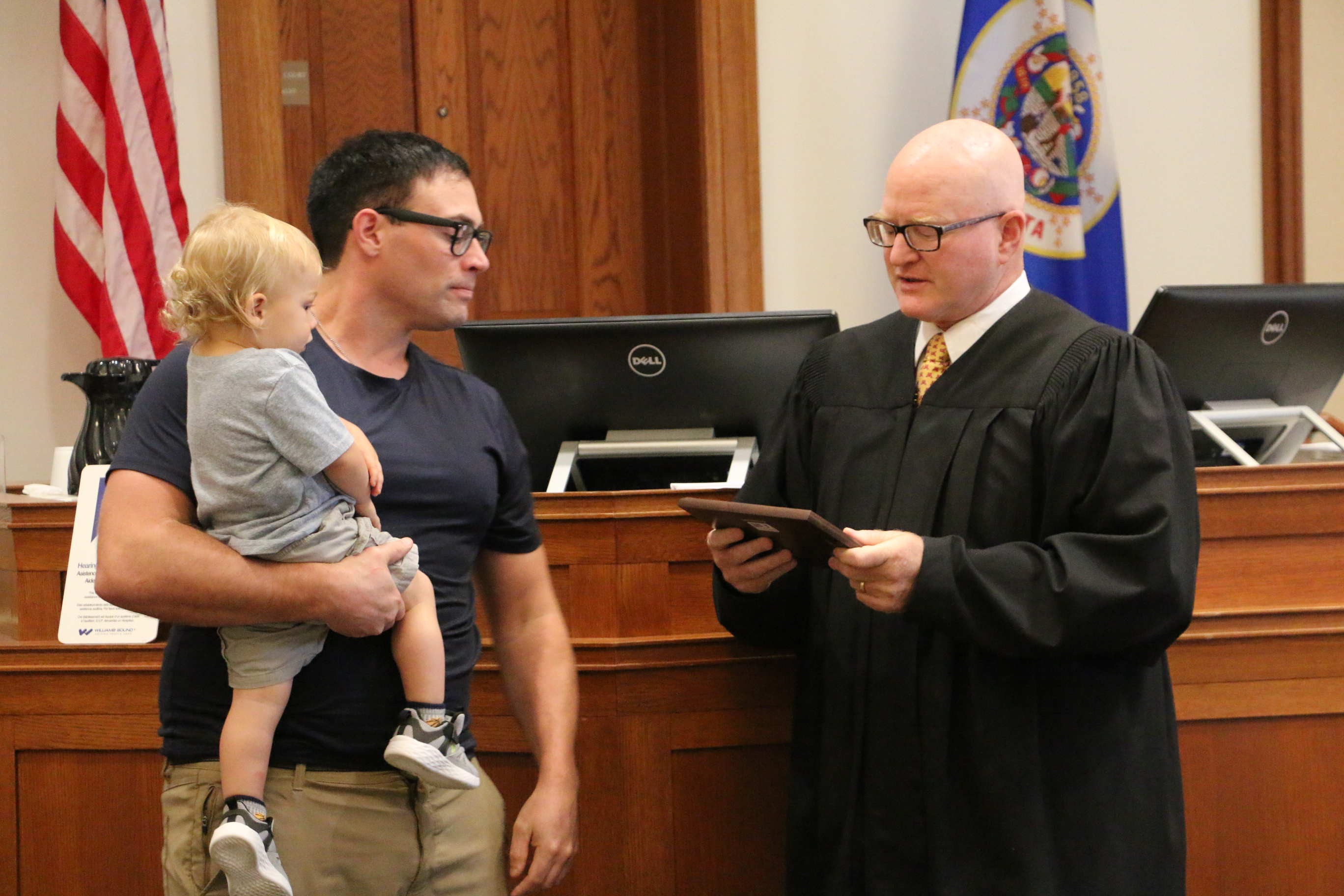
James Livingood, holding his 20-month-old son Huxley, listens to Chief Judge Joseph A. Bueltel read the plaque he earned as a Steele-Waseca Drug Court graduate. The ceremony was held last Wednesday at the Steele County courthouse. Staff photo by Joni Hubred
-James Livingood, Drug Court Graduate
Eighteen months ago, James Livingood nearly died of a drug overdose on the floor of his parents’ home.
Last Wednesday, he celebrated 16 months of sobriety and his graduation from Steele Waseca Drug Court (SWCD). The diversion program, a partnership between Steele and Waseca district courts, offers those with drug- or alcohol-related arrests an alternative to incarceration.
Livingood described a childhood in a good home with “two loving parents and a brother” and “all the opportunities one could ask for.” A friendship he made in sixth grade, he said, led him to make a series of choices that eventually led to his life-long battle with substance abuse.
“Before I knew it, I had been in prison three times… in treatment 12 times,” he said. “Drugs made me hate the person I became.”
After the near-fatal overdose–his father, a former medic, helped save his life–Livingood turned to alcohol and ended up with a drunk driving arrest that altered the course of his life.
“Without that DWI,” he said, “I know I without a doubt I wouldn’t be here. I was on a one-way road to death and destruction.”
As he faced a 365-day jail sentence, Livingood’s probation officer suggested drug court. He entered the program on Jan. 26, 2022.
Livingood is one of 200 people served so far by the program, which launched on July 1, 2014. About half have completed the program; the others either dropped out or were removed.
It’s no walk in the park; the minimum stay to complete the five phases is 18 months.
Among other things, participants are required to attend court weekly or monthly, participate in chemical dependency treatment and support group meetings, complete cognitive skills programs, submit to a minimum of twice weekly random testing, obtain a valid driver’s license, earn their GED or diploma, hold down a job, comply with child support orders, and pay off all fines, fees, and restitution.
“Drug court is a lot of work, and there’s a lot of reward,” program coordinator Nicole Grams said during a Wednesday graduation celebration at the Steele County courthouse.
It took Livingood 19 months to get through it all. He not only holds a job but has been promoted to a supervisory position. Sober for more than 450 days, he now reaches out to help others, including some of his SWDC peers. Last week, he was also looking forward to meeting with a group of at-risk youth.
“I’m going to give my testimony and hopefully, help one or two people change their path,” Livingood said. “It just gets me out of myself.”