


Ellendale teen defies the odds; teaches lessons
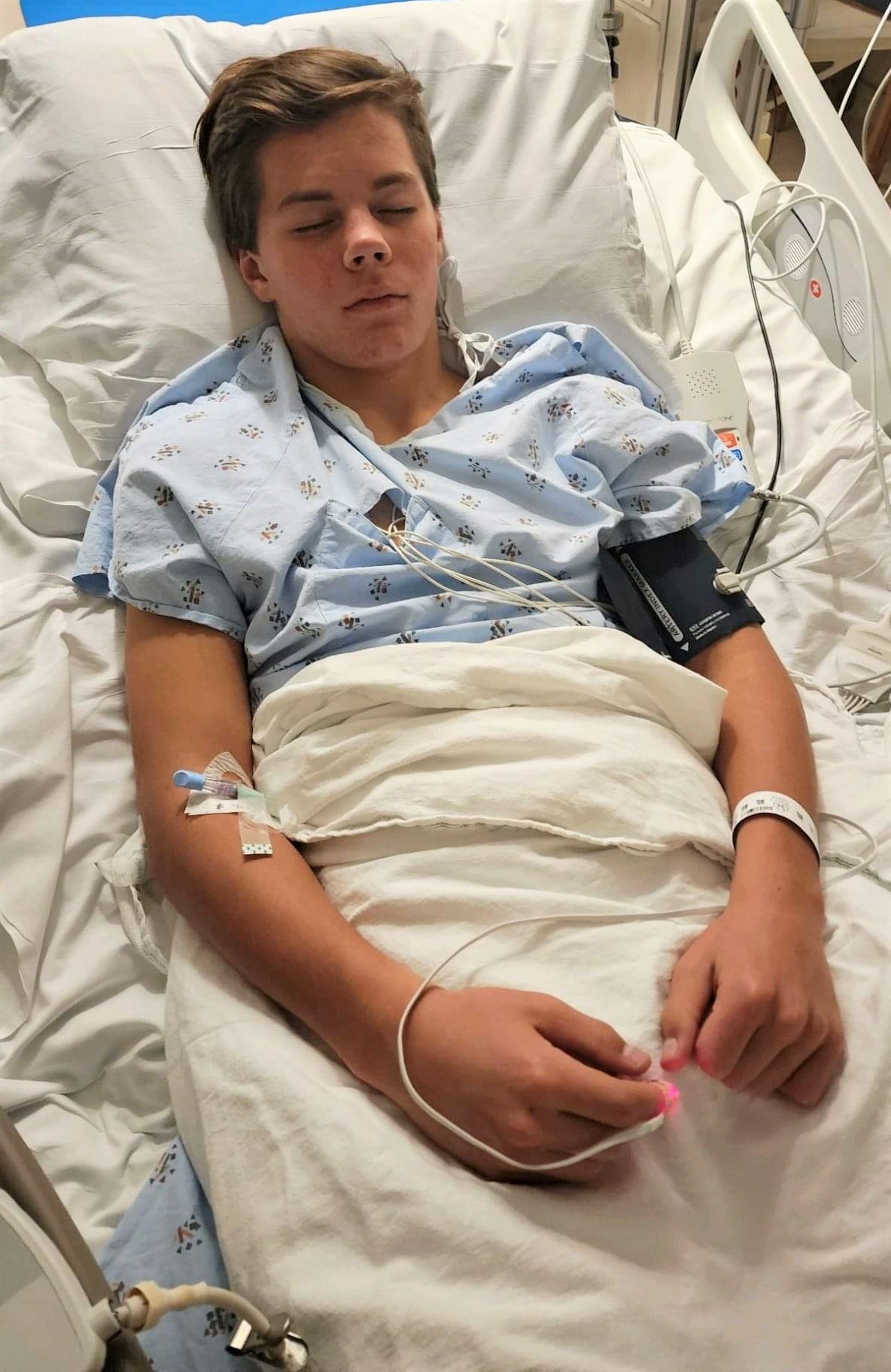
Carter Flatland, 15, was in the pediatric ICU at Mayo Clinic Hospital-Saint Marys Campus for 11 days. His heart rate was dangerously low; a pacemaker was implanted to regulate his heart. He’s the oldest of six children and the son of Brian and Jolleen Flatland of Ellendale. Submitted photo
-Carter Flatland, Living With Pacemaker
It was supposed to be a routine sports physical – so routine that the Flatland family just dropped in at a CVS Pharmacy in Lakeville.
Carter, a ninth-grader, needed a physical for winter sports.
The doctor, however, “just said she couldn’t pass me,” Carter said.
“We actually were kind of irritated by it,” said his mom Jolleen Flatland. “He’s really athletic, clearly very healthy. He’d just finished football and had a great season.”
The physician at that MinuteClinic said something about his heart rate; she wanted Carter to see his family doctor in Owatonna for an EKG.
The EKG came back irregular, and told Jolleen and Brian Flatland, of Ellendale, to get their son to Rochester immediately.
“We weren’t sure” what to think, Jolleen said. “We were still somewhat doubting, I think, because he was so healthy.”
So the family went grocery shopping first, then back to Ellendale so Carter could pack a bag.
“It was weird, because I felt fine,” Carter said, “but they wanted me in the hospital immediately, so something’s not fine.”
The 15-year-old drove them to the hospital, parked and walked into the ER with his backpack.
“There were a ton of people in the waiting room, and (medical staff) said, ‘come back right away.’ That’s when I realized they were treating it like a very serious issue,” Jolleen said.
The issue
The upper chambers of Carter’s heart – the atria – were fine, and so were the lower chambers of his heart, the ventricles.
The electrical stimulus that sends a signal from the atria to the ventricles, however, wasn’t working properly. It’s the process that coordinates the beating of the human heart.
His heart beat was irregular, anywhere between 30 and 70 beats per minute; the average is between 60 and 100 bpm. His pulse, which indicates the circulation of the blood, was only 20 to 30 bpm.
That meant his heart wasn’t pushing blood efficiently through his system; even for a well-trained athlete like Carter, it was dangerously low.
“I was just thinking it was going to be a little something,” Carter said. “They’d give me some medicine, and I’d just need to sit in the hospital for a little bit and they’d clear me. Then it kept going downhill from there.”
The signs
The Flatlands believe Carter contracted the coronavirus in December 2019 – before anyone was talking about the illness.
“None of us really get very sick,” Jolleen said, “but he was sick-sick for a couple of weeks. He was struggling to breathe; it was very abnormal.”
After he recovered, Carter still felt out of breath after doing “hard cardio, running. Eventually, I just built up (strength) and was pretty much fine. A couple of times, I noticed I was struggling running the mile, but I just thought I needed to work harder.”
The initial thought was “his lungs were potentially damaged from the COVID,” Jolleen said.
A four-sport athlete at New Richland Hartland Ellendale Geneva School District, “he kept doing back-to-back sports, so I told him not to do summer baseball (in 2021), because I wanted his body to have a chance to heal. He seemed to progressively get better after some time of resting, and we thought maybe his lungs were healing,” she said.
But this fall, “I did the 100-yard sprint in football, and that really gassed me,” Carter said. “For me, I was abnormally tired.”
Then came that routine physical, his first since sixth grade.
The diagnosis
The first theory was Lyme disease.
If Lyme disease bacteria enter the tissues of the heart, it can cause Lyme carditis, which interferes with that electrical signal from the atria to the ventricles.
“That would’ve been the best thing,” Carter said. “If they could just treat that, then that would be gone, my heart would be better, and I could just go back home, but that’s not what happened.”
When that was ruled out, doctors considered myocarditis, an issue with the lining of the heart.
That weakens the heart, though, and the cardiologists noted how strong Carter’s heart was.
“The doctors and nurses, the first time they’d come in and look at the monitors, they’d look at him and ask him if he was OK,” Brian Flatland said. “I finally asked one nurse if they ever see heartbeats this low – because we were in the cardiac ICU – and he said, ‘uh, only when we’re bringing in the defibrillator to resuscitate.’ I’m like, that’s why everybody’s coming in here with big eyes.”
Carter’s heart rate was dropping every night; the lowest recorded was 20 beats per minute.
“He was a marvel,” Jolleen said. “People were coming in to watch the (heart) rhythm and study the screen. There were six, eight, cardiologists in there who said he could make the medical books – they’d never, ever, ever seen anything like this before.”
Eventually, the heart damage was deemed either COVID-related or genetic.
The results of genetic testing aren’t back yet, but “neither of us have had any issues,” Brian said. “No heart issues in our family on either side.”
The treatment
After two days of testing and studies, doctors determined a pacemaker was needed to fix the issue – but there were no surgical openings for four days. Carter had to stay in the ICU to be monitored until the Nov. 8 surgery could be performed.
“His stress relief is music and exercise, so being bedridden was really the hardest thing for him,” Jolleen said. “That, and having to wear that gown.”
Carter was released from the hospital Nov. 13 after recovering from the abdominal placement of the pacemaker.
“They put it behind the abdominal wall so he can continue to play contact sports,” Jolleen said. His heart, she said, “is incredibly strong; scary-strong. After he got the pacemaker and was coming out of anesthesia, his whole body was twitching to the movement of his heart beating.
“He had conditioned his heart,” she said. “I liken it to an endurance athlete.”
For now, the pacemaker is doing a lot of work.
“We thought it would only have to kick in every once in a while,” Jolleen said, “but we found it’s firing every single beat, so he needs it always.”
The lessons
The doctors still aren’t sure what happened to Carter’s heart, his parents said.
“There’s so much unknown about COVID damage,” Jolleen said. “Can it heal and repair itself, or did it just destroy it? They’ll continue to monitor, but they’ll be able to tell if (the pacemaker) is still firing.”
Young athletes collapsing on the field or the court during a sporting event is an unfortunate reality, but that’s not what could have happened to Carter.
“With his condition, it wouldn’t have been on the field,” Jolleen said. “It would be when he was sleeping. It would have only taken 10 minutes after he lost consciousness, and he would’ve been brain dead.
“He could have been suffering with this for the last three years,” she said. “I told him, ‘Carter, you already were a miracle before you went into the hospital. At any time in the night…”
Carter feels “really great, actually,” though he admittedly never felt sick.
“I’m just honestly pretty amazed,” he said. “It’s not something that I thought would ever happen to me, so it’s kind of shocking to experience it. It’s amazing that I’ve been able to recover so well.”
“Carter’s faith is really important to him,” his mother said, “so we continue to pray for him, that he would be completely restored and healed. It was really powerful how Carter processed and was strong through all of this, and that helped all of us be really hopeful and strong.”
He came to three realizations throughout the ordeal:
“First, not to take things for granted,” Carter said. “When I was in the hospital, they wouldn’t even let me walk around. Just be grateful for everything you have.
“Second, a lot more people cared about me than I realized,” he said. “I have a hard time, sometimes, feeling like I’m all by myself. That encouragement and support meant a lot.”
And finally, “just have faith. It’s the only thing I could control in that situation, so I had to believe that God can do great things for me, and he’ll protect me.”
The future
Carter heads back for a check-up at the end of this month when he’s hoping to get the all-clear to become physically active again.
“I think I’ll be able to wrestle, toward the end” of the season,” he said.
“What we’re interested in is once he gets cleared for sports and he can really go hard, to see how he feels then,” Brian said.
The pacemaker’s system keeps all the data while Carter sleeps, and automatically sends a weekly recap to Mayo Clinic. An alert system detects any concerns, and the Flatlands will be called to the hospital.
“They can run diagnostics on it; they’ll see how much it’s firing,” Jolleen said. “If his heart heals, they’ll (eventually) take it out.”
Still, he could have it “5 to 15 years, depending on how much it gets used,” before the battery or the pacemaker itself need replacing, she said.
Carter, the oldest of six children, will finish ninth grade at the end of January. He and his siblings are home-schooled, but the entire family is active within the community and their church.
“It’s been exciting now to share (Carter’s story) with people,” Jolleen said, “because it gives them hope in their situation. Now the medical bills are rolling in … so even with gratitude comes reality. We’re grateful for the community support.”
Brian is on the Ellendale Fire Department; the Relief Association sponsored a benefit for the family on Dec. 4 to help defray expenses.
“It’s hard to receive … ” Jolleen said.
“…but it also blesses others when you do,” Brian finished.