


State’s top justices visit Owatonna for 40th anniversary
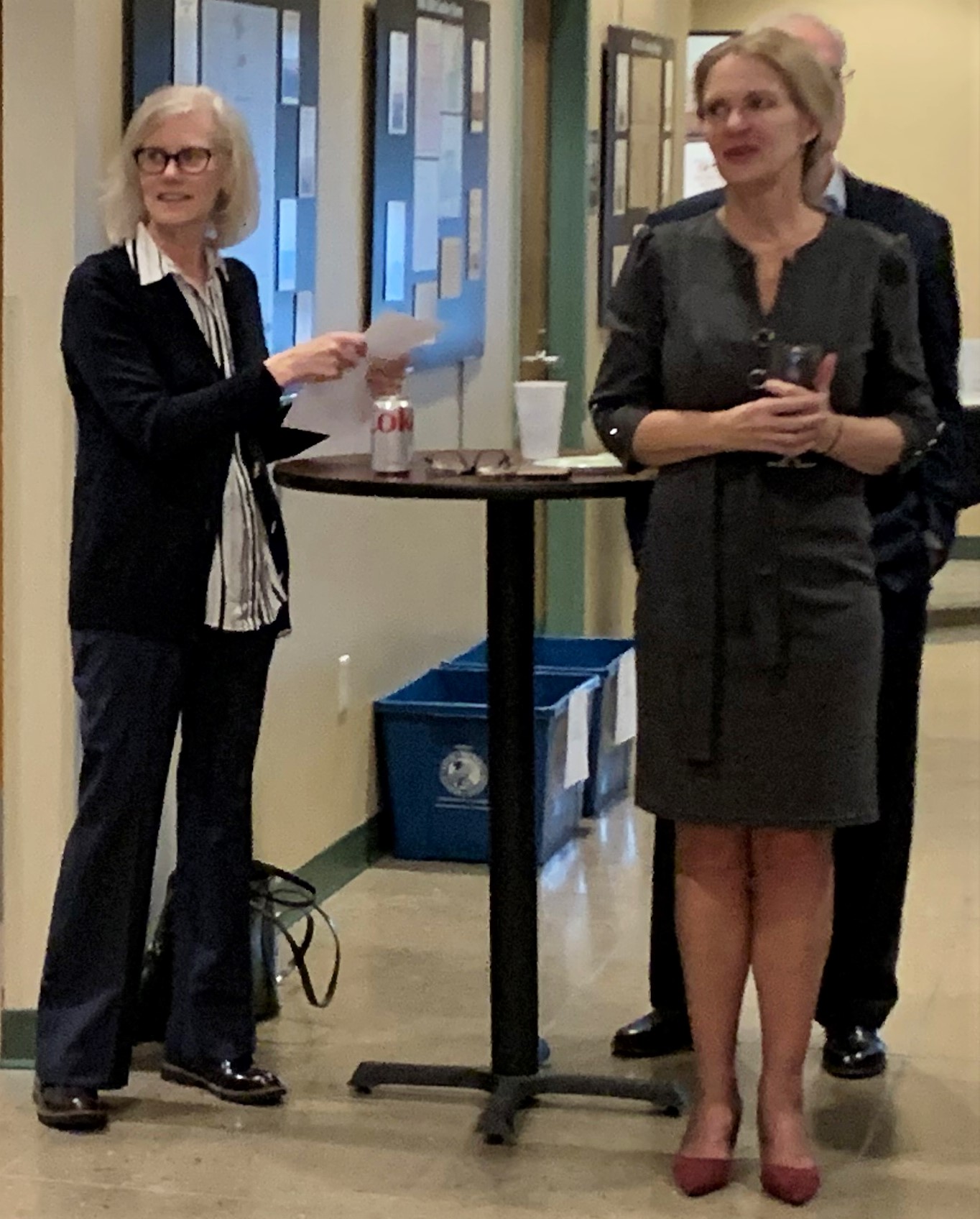
Tracy Smith, left, and Renee Worke, both of Owatonna, are judges on the Minnesota Court of Appeals. Worke is the longest-serving justice on that court; she was appointed in 2005 by Gov. Tim Pawlenty. They were part of the 40th anniversary celebration of the court that was held in Owatonna last week. Staff photo by Kay Fate
What do Bing Crosby and the Minnesota Court of Appeals have in common?
Plenty, said Barry Anderson, a senior justice of the Minnesota Supreme Court. He was in charge of weaving the history of the state’s appellate court during the first stop on a statewide tour to celebrate its 40th anniversary.
Some of his colleagues on the High Court, as well as judges from the state Court of Appeals joined him in Owatonna last week for a presentation on the history and evolution of the Minnesota Judicial Branch.
Crosby, Anderson said, “was a cultural giant of the first two-thirds of the last century … He was probably the most popular movie star in a way in which only Tom Cruise could make a similar claim. But in the 41 years since he dropped dead on a golf course at the age of 74, he’s been almost completely forgotten.”
So what does that have to do with the Court of Appeals?
“That remarkable story about Crosby’s life, like the remarkable story about the Minnesota Court of Appeals, is largely unknown to lawyers who are beginning practice these days,” Anderson said. “They assume that which is now, has been always – but in fact, there hasn’t always been a Court of Appeals.”
Though the state’s Supreme Court has been around since Minnesota became a state in 1858, the appellate court is a relative newcomer, legally speaking.
It heard its first case in November 1983, following a constitutional amendment vote in November 1982 that authorized the body.
A state intermediate appellate court had been discussed since the 1940s, Anderson said, but by 1980, “the workload (for the Minnesota Supreme Court) had become unmanageable.”
The number of filings had grown from 213 in 1957, to more than 1,800 in 1982 – an increase of more than 700% -- and then-Chief Justice Doug Amdahl began a campaign to get some help.
The seven Supreme Court judges had by then broken into panels of three in order to divide the caseload; they stopped hearing oral arguments in most cases.
Rulings were no longer explained in detail, Anderson said: “You’d get a letter in the mail, with no explanation” of the decision.
There was division, even among the Supreme Court judges, on how best to handle the formation of an appeals court, he said, in what was a “very complicated political process.”
First-degree murder cases, for example, aren’t heard at the appellate level, nor are cases involving elections. Appeals from Minnesota Tax Court and workers compensation cases also go straight to the state Supreme Court.
“But the most important political decision was the promise to provide more oral arguments at the court of appeals,” Anderson said. “Today, at least half of the cases that receive final disposition get oral arguments. It’s unusual; around the country, that number is typically 5%, 8%, but it was a promise that was made to the lawyers and people of Minnesota.”
In addition, all decisions rendered from the state’s Court of Appeals must be filed within 90 days; judges must be chosen from around the state; and the court is required to hear cases in places other than just Minneapolis and St. Paul.
“I was privileged to serve on the Court of Appeals from 1998 to 2004,” Anderson said, “and those six years were very formative for me. I really appreciated the opportunity to serve that court.”
And, “as promised,” he said, “the backlog was alleviated. The Court of Appeals is the final stop for about 95% of the cases before that court.”
The Supreme Court today receives 600-700 filings annually.
Tracy Smith, of Owatonna, is one of the 19 judges on the Minnesota Court of Appeals. So is Renee Worke, also of Owatonna – and the longest-serving judge on that court.
Smith comes from a family of attorneys, including her father John Smith, and brother, Steve Smith, who both practiced in Owatonna.
“I thought about being a lawyer when I was a little girl,” Tracy Smith said during last week’s presentation, but she wasn’t set on it.
“Then Steve went to law school at the University of Minnesota, did extremely well, got a fancy New York job with a prestigious firm,” she said. “And I thought, ‘wow, if Steve can do that, how hard can it be?’”
After the laughter died down, Smith went on to describe her own path to the bench, including working for the Minnesota Attorney General and at the U of M, before being appointed to the appellate court in 2015.
Women are now the court majority; Susan Segal is the chief justice.
She took the bench in November of 2019 and was appointed chief when Justice Ed Clary retired in May 2020.
Segal found a tangible reminder of how important that court is when she moved into that role.
“I found a campaign poster (from 1982) in my office that says, ‘If you think Minnesota winters are long, you haven’t tried appealing a case in Minnesota.”
She was glad to be in Owatonna, meeting lawyers and judges from the district.
“We’re a statewide court,” Segal said, “so it’s really important to us not to just be in St. Paul.”