


Legislative candidates take the stage
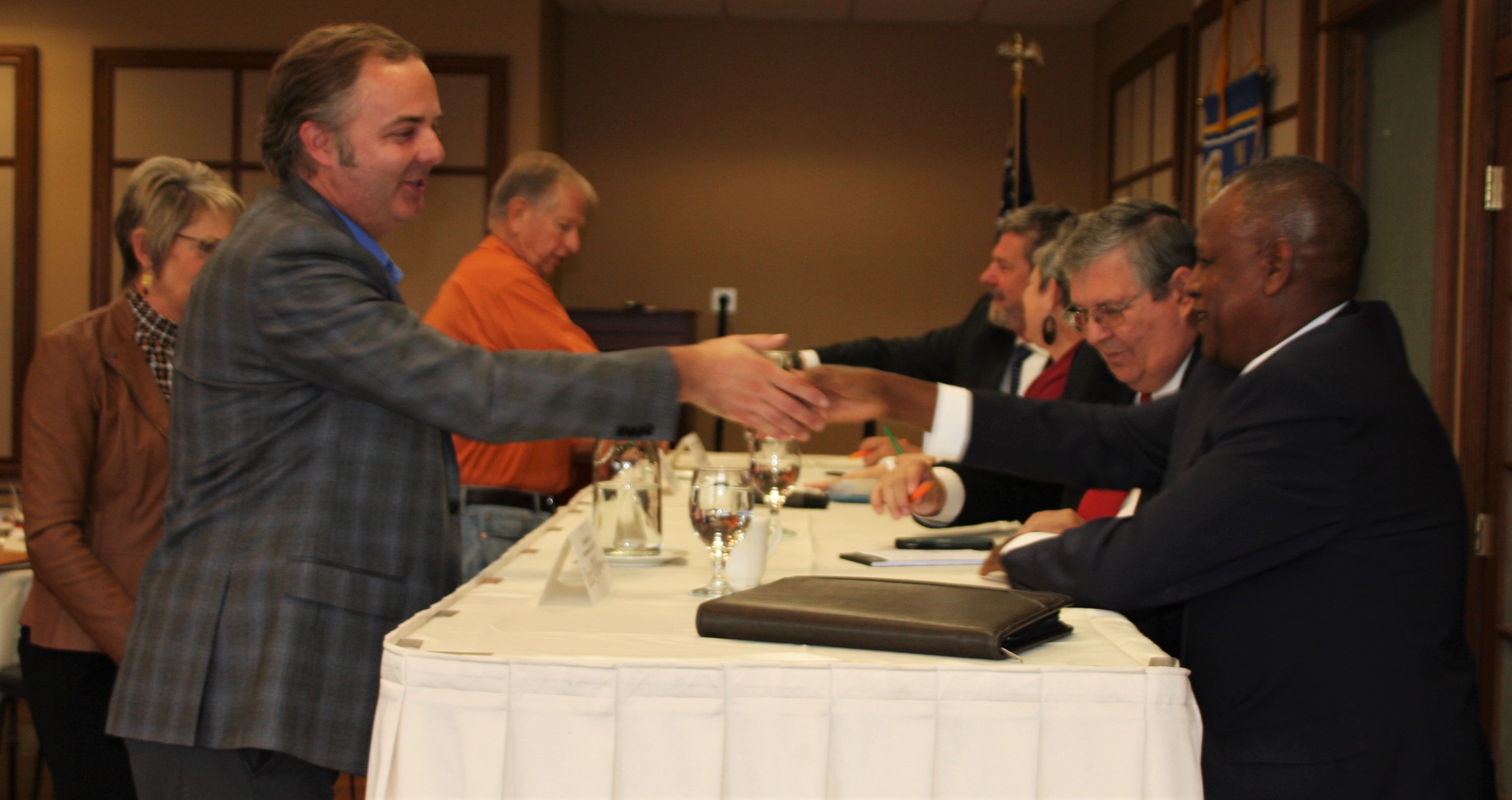
Following Monday’s candidate forum for state legislative offices, several of the participants and sponsors greeted the candidates. They included, clockwise from lower left, Brad Meier, President/CEO of the Owatonna Chamber of Commerce; Julie Rethemeier, who moderated the forum; Owatonna Mayor Tom Kuntz; Sen. John Jasinski; Kate Falvey; Rep. John Petersburg and Abdullahi Osman. Staff photo by Kay Fate
People often talk about a “mic-drop” moment, but rarely see one – especially during a political forum.
It happened Monday, though, when candidates vying for seats to represent Steele County in the Minnesota Legislature met to talk about the issues.
The response came during a question from the audience about abortion, and it came from the only female on the dais.
Kate Falvey, who is challenging Sen. John Jasinski (R-Faribault) for District 19, was the last candidate to answer:
If legislation was presented to ban abortion in Minnesota, how would you vote?
“I’m just going to say no, and mic drop,” said Falvey, a DFLer.
Her opponent, who called the topic “the only thing they can come at Republicans with,” said he was pro-life, but “there are considerations for rape and incest and mother’s safety,” and things would likely not change much from the current status.
The candidates for the House in District 19B also split along party lines, with incumbent Rep. John Petersburg (R-Waseca) also describing himself as pro-life, before saying “without seeing the bill, it’s very difficult to tell” how he would vote.
His challenger, DFLer Abdullahi Osman, of Owatonna, said he would vote no, “unequivocally, because it’s nobody’s business” but the woman, her family and God.
Several of the questions addressed the economic climate in the state, asking about business competitiveness, the workforce shortage, and the role of government in workplace policies.
“On paper, Minnesota looks like a pretty good business climate, because we have a lot of Fortune 500 companies housed here – but virtually none of them are expanding here,” Petersburg said. “When we start looking at some of the costs for businesses, we’re really kind of encouraging people to leave the state and making it less competitive.”
Jasinski echoed his counterpart in the House.
”People are leaving Minnesota, and they’re leaving Minnesota with a lot of wealth,” going to more tax-friendly states, he said. “The population we’re seeing increase is from the lower incomes … that can’t work long-term, because the tax base is leaving and the people coming into the state need services. We need to make sure we’re not losing our wealth and experience to other states.”
Osman saw things differently.
“Minnesota’s economy, compared to other states, is not bad,” he said. “It’s the middle of the pack. Unemployment is low, economies are growing, but what needs to happen is a holistic approach, creating a populace that’s happy” with its healthcare, childcare and educational opportunities.
There was agreement, mostly, about the state’s budget surplus – though not about how, exactly, to use it.
Petersburg said that in his 10 years in office, “we have consistently over-collected dollars that the state just doesn’t need.”
While allowing there are state-funded programs that should be reassessed, “I understand that every dollar we keep in a taxpayer’s pocket is going to rotate through the community between five and seven times,” Petersburg said. “If it stays in the state coffers, it’s only going to rotate around once or twice – so that means our economy actually grows faster when we have it in peoples’ hands.
Osman agreed – to a point.
“Having a surplus is not a good idea,” he said. “Either you’re collecting too much, or you’re not doing what you’re supposed to do with what you have.”
Osman believes there’s “not enough investment in education, especially early education.” He’d like to see the surplus spent on “uplifting the bottom part of the population, to create more opportunities, more training and more affordable housing.”
The $7.2 billion surplus, Jasinski said, means “we definitely need to give tax breaks to keep people here in Minnesota. I think we’re open to some spending, but we need to focus on one-time spending.”
He took exception to Osman’s suggestion to invest in education, saying that “education is now 41% of the budget, but literacy rates are going down. That money should be spent well, and in the right area.”
Falvey, a high school teacher from Faribault, saw a way to compromise.
Literacy, she said, in response to Jasinski, “is where the early childhood funding comes in, and making sure our students are getting a good base. Obviously, we want to do both: Reduce taxes and put money into (state) programs. We shouldn’t have a surplus – it should be balanced.”
All four candidates believe the tax on Social Security should be eliminated; their views on strengthening the work force, however, varied.
Jasinski said the American work ethic is changing, “and we need to get it back.” He believes people should be “incentivized to get back to work,” instead of being incentivized to stay home.
Petersburg took a more basic stance, allowing that people typically work for one of two reasons: “They need money to live, and the other is, it’s a way for them to feel fulfilled and be productive. The challenge is, if they don’t need the money yet, because of social programs,” they aren’t going to work.
Falvey had a different perspective.
“It appears the jobs that we have in society that care for people – nursing, elderly care, our law enforcement and our teachers – have slowly, somehow, become less and less respectable as a job,” she said. “As a society, that’s a change we have to make, but I know changing people’s hearts isn’t as easy as making incentives for people to go back to work.”
Each candidate was asked to name two skill sets they possess “that will result in good representation.”
The mood lightened considerably when Osman described himself as “a charming person who can talk to a lot of people. I consider Mr. Petersburg my good friend,” he continued.
“I know a lot about politics, both nationally and internationally, but mostly, I carry the ability to speak for the silent part of the community,” Osman said. “I speak different languages; I’m a Muslim, I’m an African, I’m Somali … I want to give back to the community and see a representation or a voice that might be missing as the community changes.”
Jasinski said he thinks of himself “as a problem-solver, not a politician,” who is able to “establish relationships across the aisle, with lobbyists and with citizens.”
Falvey said she, too, “is big on relationships,” and has been a leader in many organizations.
“I make sure everybody is addressed as a human first, then we work together and find connections that way.”
Petersburg said the ability to listen “is one of the most important things we do. I think I do that well; I don’t always agree, but I listen.”
He, too, prides himself on his ability to work across the aisle, saying he accomplished more when he was in the minority than when he was in the majority.
“I’m truly interested in what’s going on,” he said. “I show up, I listen and I do the work.”