


REUNITED AFTER 50 YEARS
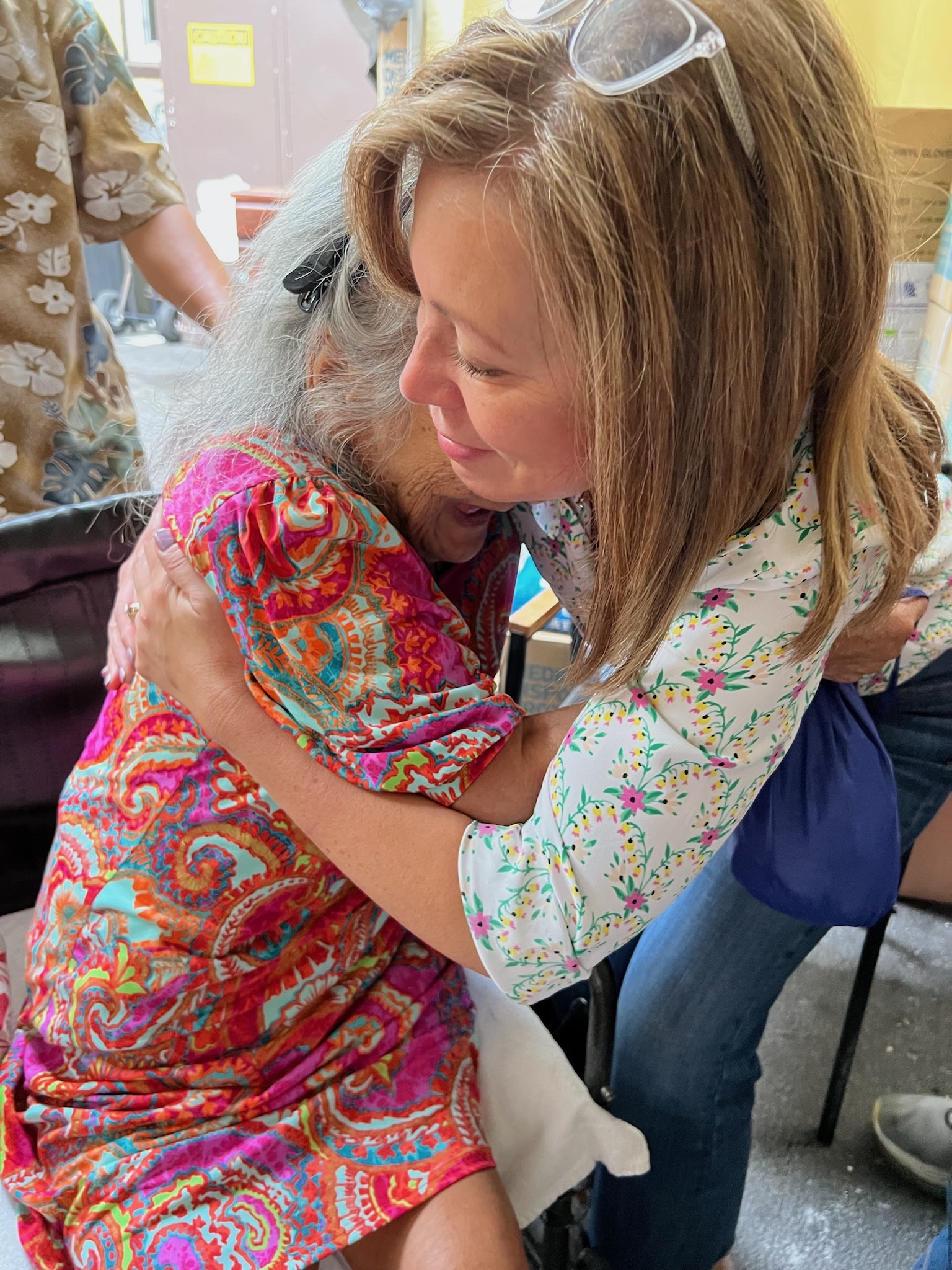
Peng Olson embraces her mother for the first time in 50 years after being reunited with her on Sept. 8 at a skilled nursing facility in the Los Angeles area. It was the first time Olson, 55, had seen her mother since she was 5 years old. Submitted photo
-Peng Olson, Reunited With Mother
Shadows beyond the Vietnam war, psychiatric institutionalization, the collision of two cultures a world apart, and years of dead-end search activity created a perfect storm preventing a woman from seeing her biological mother for the past 50 years.
But for Peng Olson of Owatonna, none of it was enough to stop her search for her biological family and reuniting with her mother, who she last witnessed being removed from the home by law enforcement when Olson was a 5 year old.
“My last memory was her looking over her shoulder at me through the window of a police car,” said Olson. “It was seared into my brain and memory,” not realizing that particular moment would change the trajectory of her life.
Officers had responded to Olson’s childhood home in Sioux Falls in 1972 for what had been an “encounter in the home,” though she has no recollection of why the police ended up at their house.
Police took Olson’s mother to the state hospital in Yankton, S.D. (We are not identifying her name and other relatives out of respect for the family.) At a young age, Olson knew that her mother was in a hospital but that was all she knew. This would begin a long 50-year journey of Olson attempting to locate family and reunite with her mother.
“I ran into so many road blocks that I thought I would never find them and get there,” Olson said.
However, she did get there, though it wasn’t easy by any means.
In early September, she reunited with her mother. An emotional experience in the Los Angeles area.
This is an enduring and heart-warming story of faith, hope and perseverance mixed in with inspiration and human emotion. For Olson, it’s one that she never thought would happen and is incredibly grateful and thankful for this holiday season.
Olson’s childhood
Olson’s parents were married in May 1967 in Saigon, Vietnam. Just a few months after the wedding, her father returned to the United States with his bride, a new immigrant joining the American way of life. Olson was born in Pierre, S.D. in August 1967. A sister came along the following year in 1968.
While there aren’t many, Olson does have some childhood memories of her Chinese-Vietnamese mother. She recalls her mom sharing noodle soup, brewing hot tea, use of chopsticks, and listening to Asian music cast from a bright yellow vinyl LP record.
Olson also recalls visiting her mother once in the hospital and sharing a Twin Bing candy bar with mom.
“I was sitting in the hospital cafeteria and that’s what I remember having,” she said, adding she did not like the candy.
Her father filed for divorce in 1972, and he moved the family to Nebraska. He remarried in the fall of 1973 and it was a chance for new beginnings. Olson said any chances of a relationship with her biological mother slowly faded away.
“My stepmother came into my life, and I quickly learned to call and embrace her as mom,” Olson said, adding that’s exactly what she did.
Growing up, Olson carried distant memories of her mother but often shied away from discussing them. She found that she was to reform herself in a quiet grieving world that continued on. “I always had this shadow, knowing it was out there and wishing that my mom was part of my life,” Olson said. While her world view was being shaped and had not developed, it was something she never stopped thinking about.
Before and during Olson’s childhood, her father was enlisted with the US Navy. He served active duty from 1964–1969 and continued as a Reserve member until 1992.
During the Vietnam conflict, Olson’s father was headquartered in Saigon with the Military Assistance Command, Vietnam (MACV). As part of the J2 intelligence team, he worked on classified interrogation missions in south Vietnam. He returned to the states just weeks prior to Olson’s birth, and was reassigned to work at the Pentagon in Washington, D.C.
“He encountered some very traumatic experiences,” Olson said, sharing her father was involved in “several killed in action” incidents during his service, although she didn’t want to reveal the exact number.
While Olson had a loving father and stepmother, she often walked on eggshells – careful with her actions and inquiries which seemed too painful to discuss. For example, if her father was napping, Olson knew better than to tap his shoulder or it could send him jumping. His war trauma led to severe bouts of PTSD (post-traumatic stress disorder) and nightmares throughout the years.
“He had military combat. This is the eggshell dance we did. I didn’t want to trigger anything based on what he experienced,” she said.
At 7 years old, Olson recalled being home alone with her younger sister and finding her father unresponsive, not realizing what attempted suicide was at the time. After running to the neighbors, emergency response vehicles were at the home once again.
Her father’s PTSD was just one of many complicating factors when it came to Olson learning more about her mother.
“I did have questions, but I didn’t talk about them,” Olson said. “There was always that shadow, because of dad’s PTSD. Intuitively, I knew not to talk about it, more out of fear it could trigger an episode with dad’s PTSD.
“I also didn’t want to upset my stepmom by the desire to know more,” Olson said, adding her childhood was sometimes a place of pain and emotion for her.
Amerasian background
Another complicating factor along Olson’s trail to finding her mother had to do with understanding and embracing her ethnicity. She struggled with her Asian looks and identity, heeding that inner voice that told her, you are different, you aren’t like the others, you won’t measure up so don’t even try.
“I always knew I was different than everybody else,” Olson said. “My first name was Chinese, and I was small. I was always picked on and had to check the box of Amerasian.” This time-faded ethnicity label was given to children born during the Vietnam conflict that often-left Olson wanting to run away from who she was.
“I certainly questioned my Amerasian identity—another shadow,” she said. “I know what it’s like to be called chink, half breed, yellow face, to be asked ‘do you like dog.’ I know that humiliation, I know the pain.”
For years, Olson carried feelings of shame and that she wasn’t loveable. She felt she couldn’t show parts of herself. She carried a different point of view than those around her.
“I always felt plagued,” said Olson. “It had to do with all the challenges I experienced growing up.”
And, she said, her dad’s PTSD and volatile marriage made things even more complicated and confusing for her.
But somehow Olson kept moving ahead.
She is the first in her family to obtain a college degree, in business administration. She also went back to get a master’s degree in organizational leadership and management.
“I really pushed myself,” she says. “I am a bit of a survivor.”
Finding mom
By 2000, something inside Olson had changed. She began a vigilant effort to find her mother.
“I knew at that time I needed to find her,” Olson said. “I wanted to have that connection. I was living my life as an adult, and wanted to reconnect. I felt that without finding her, who am I?”
Olson focused on whatever she needed to do to make the discovery.
By now, Olson knew finding mom wasn’t going to be easy. The search process would take dedicated time as it competed with Olson juggling a busy life of professional work and raising her own family.
“It was like reading a book. You read for a while and then put it back down.”
She began with the most logical step—a call to the state hospital in Yankton, S.D., where mom was last known to be.
She gave the hospital worker, background information on her family and history behind what had happened to her mother. And then she was unpleasantly struck with the hospital’s response: “I’m sorry, HIPAA privacy law prevents us from sharing information with you.”
But her luck changed two days later when she received an anonymous phone call.
“A Good Samaritan called me,” Olson said.
That Good Samaritan happened to be the same person from the state hospital that rejected Olson’s call just days earlier. She offered a sentiment of kindness for Olson’s situation and explicitly informed her, “We did not have this phone conversation.”
After combing through several years of hospital paper medical records, the hospital worker provided Olson with key information about her mother, most notably the fact that biological family members transferred her mom from the South Dakota facility to California in 1985. The hospital worker also told Olson that her grandparents were able to get out of Vietnam and resettle in the United States.
Then Olson was presented with her mother’s birthdate, social security number, as well as the Asian first names of uncles, aunts, and grandparents, none of which Olson previously had. Olson captured the information in a small notebook covered with smiley faces. It is a notebook that remained with her for the next 22 years and would someday prove to play a pivotal role in solving this search mystery.
“Your mom remembers you,” the Good Samaritan told Olson.
“That brought me to tears,” Olson said.
“She had a lot of compassion. There are people in the world that listen with their heart, and she probably used her head to a degree,” Olson said of the mysterious woman. “I remember being so surprised that this individual felt compelled to reach out to me to provide key information.”
Looking back on the Good Samaritan phone call, Olson gets choked up about it even today.
“I appreciate the fact that she reached out to me. I get so emotional thinking about it,” Olson said with tears in her eyes. “She was the missing link.”
While getting some vital information was crucial for Olson, she still had a long way to go in finding her mother.
Olson believed her mom was in the Los Angeles area but had no additional information as to her whereabouts. She had randomly reached out to one facility in California and received no response back.
At that time, Olson had three children of her own ranging from an 8 month old to a 6 year old.
“Life was crazy,” Olson said. “For me it was always juggling that prioritization of finding family.”
Olson had no connection with any of her mother’s family members. The only thing she had to work with were a few first names provided through the medical records from the Good Samaritan.
She employed various methods in her vigilant effort to find mom. She made countless phone calls seeking direction on how to find missing loved ones. She reached out to adoption agencies to identify approaches they might recommend. Badly translated names, faded photos, and half-forgotten memories were all that she had to work with.
Technology eventually joined Olson’s side as the internet had made significant improvements by 2014. She used people and public search websites like peoplefinder.com and intellius.com
She started with an aunt’s name, and ended up with reports that produced a “slew of names,” mostly Vietnamese, Mandarin, Cantonese and some English.
“I didn’t know how to make heads or tails of it,” Olson admitted.
And what she discovered wasn’t what she had hoped for.
Some of the people cited were deceased. And Olson believed one to be her mother, though there was no way to confirm it.
“I was really sad,” Olson said. “I shed tears thinking I’m never going to have that chance (to reunite with mom).”
As she did numerous times before, she shelved the effort in finding mom, but never with the intent to give up hope.
Vietnam trip and more
In 2019, Olson traveled with her husband, Bob, to Vietnam for a few primary reasons.
“My objective was to experience the culture, locate my mom’s family home and see where my dad served during the war,” she said. “I wanted to see and feel it.” Olson had a photocopy of the marriage certificate which revealed the family address.
Keep in mind that, during this period, she believed her mother was deceased.
And she encountered another roadblock.
The city of Saigon had been renamed years earlier after South Vietnam fell to the North’s military. Even the names of streets had been changed. She obtained the aid of resources at Ho Chi Minh University, to help retrieve archived maps in hopes of identifying former street names and an address.
It worked. She finally located her mother’s family home in Ho Chi Minh City, once known as Saigon.
“It was heartwarming for me to find it and gave me a feeling of connection,” Olson said. “That’s where my mom and dad lived, and my mom was pregnant with me there.”
The Olsons also traveled to Can Tho, located in Vietnam’s Mekong Delta region, where her father carried out classified military missions.
The trip inspired Olson to keep digging for family back home.
She joined a couple of private social media groups, AmerAsians DNA and Vietnam Veterans and Amerasians United, which help AmerAsians connect, share experiences, exchange information about the war, and reunite family members with one another. “I was looking for guidance,” Olson said. “Within the dialogue (through social media), there were search angels—volunteers to give you guidance.”
One of the suggestions she received was to do her own DNA sampling. She started down that path by providing DNA to a variety of third parties, and hit another roadblock.
“I was frustrated because my DNA wasn’t amounting to anything,” she said.
A random message
Remember the handy dandy notebook with smiley faces - the one that Olson captured notes in after the Good Samaritan contacted her back in 2000? Late summer this year, she leaned on it yet again, combing through those notes to try and make sense of it all.
Olson continued to manipulate and play with various configurations of the translated names in her notebook. She also decided to obtain a refreshed people search report with a newly paid online subscription.
Then something caught her eye. It was a name in her notebook that closely corresponded with one cited in the new people search report.
On Aug. 7, Olson sent a private Facebook message to the name she had come across.
The message began, “This is a random message. My name is Peng and I have been searching for my mother and her sisters and brothers for more than 20 years… (she discloses her mother’s name)… this is a long shot but I’m wondering if you are related to any of them?”
The next day on Aug. 8 at 8:56 a.m. Olson received a response, and it’s one that changed her life forever.
“This is Peter from VN… and (Olson’s mother’s name inserted) is my sister and you are her daughter Xiao Peng.”
Olson was set to go into a work meeting at 9 a.m. at Federated Insurance, where she has been employed for many years.
“I started hyper-ventilating,” Olson said. “I was stunned because I was looking for so long. A plethora of emotions went through me. I was astonished. I was curious. I was overwhelmed.”
She asked herself, “Is this for real? Did this just happen?”
And then she sat down and cried.
“I knew it was for real, and I couldn’t believe it.”
After composing herself, she headed to her meeting and responded back at 9:52 a.m. to what turned out to be her uncle who lives in California.
“Oh my goodness! Thank you so much for responding. I’m literally filled with happy tears. I’m so thrilled to have found you,” Olson wrote back to her uncle. She also sent him a photograph of the original family home in Vietnam.
The uncle responded, “Yes that the house we live in the past over 52 years when I came here in my heart was always tried to find you and your sister I cried out from God to help and believing on some days will found both of you amazing true love come to our family.”
In the days following, Olson kept in contact with her uncle. “My mom, you and family have always been in my soul. I am truly elated—so delighted and filled with unspeakable joy,” she wrote.
Finally reunited
On Sept. 8, Olson flew out to the Los Angeles area where she met uncles, aunts, and cousins from her mother’s family.
And then the moment she had been waiting on for 50 years happened.
She was reunited with her mother at a skilled nursing facility in the Los Angeles area. Nursing staff wheeled her mother out in a wheelchair for the moment that seemed to be an eternity.
“I will never forget it,” Olson said. “I felt like this little kid again. I’m a 55-year-old woman, and I feel like an 8-year-old again. It was super emotional. I had joy and was overwhelmed thinking I would never have that moment.”
She was filled with even more joy when her mother told her she remembered who she was.
“She said, ‘Mommy loves you’ in English,’” Olson said. “I couldn’t even talk because I was bawling.”
Olson brought her mother a special gift, a Catholic Bible in Mandarin.
Her mother is 77 years old and fighting chronic obstructive pulmonary disease among other medical issues. And while her health isn’t the greatest, Olson found her mother to be “pretty relaxed and happy.”
Since being reunited with her mother, Olson made another trip back to California in early November. And she expects many more trips are on the horizon.
“I have a lot of years to make up for. In my mind, this is just the beginning,” Olson said fighting back tears. “I grieve. I am very sorrowful for the last 50 years lost, but I’m in such a good place to open the door for what comes next.”
She is counting her blessings.
“I never forgot her, and I don’t feel forgotten either. I’m such a basket case.”
Focus shifts to mom
Olson’s focus now turns to helping mom live out her remaining years in a healthy and safe environment.
Her goal is to transfer her mother by early next year to a care facility closer to her uncles and aunts. However, Olson already knows that it won’t be easy, as she will have to navigate the hoops and hurdles of understanding Medicare, Medicaid, Social Security, and options for skilled nursing care facilities.
“It’s very complicated to navigate that system,” Olson said, quickly adding she is putting herself out there to help her family members with English communication difficulties, and guiding them with health care rules and unwritten patterns of dos and don’ts. She couldn’t imagine being in their shoes trying to get through the complex healthcare benefits system and doing what is best for her mom.
To a degree, “they are vulnerable,” Olson said of her family. “I feel a sense of responsibility to help support them and I’m willing to be an advocate and communication bridge.” She added that life hasn’t always been the easiest for them and how she admires their intelligence, resilience, and human spirit.
Olson also plans to become the successor conservator for her mother by next spring.
Upon one of the return trips home, Olson and her uncle continued to exchange messages. “… A heavy rock inside my heart finally could lay down for your mom and I believe all the blessings was from God. You know the traditional Chinese culture is that children are filial (a display of loyal affection) and caring and it is necessary to know how to be grateful to their parents first…” the uncle wrote.
Olson shared with her uncle how she has experienced “the most meaningful days of my life” while visiting them. “I had a very difficult time saying goodbye to you and my family tonight. I was sad to have to leave yet I feel a little more at peace and happy,” she wrote.
A life changer
For Olson, being reunited with her mother and family brings inner peace.
“It filled this part of my soul that had been missing for so many decades,” she said. “It truly was a gift for me.”
Asked if the reunification has changed her life, Olson says it will definitely change who she is in terms of where she will focus her commitment.
The longtime community advocate pointed to her recent run for Owatonna City Council. Olson discovered her biological family and news of her mom still living one week after filing for the position. She indicated she’s not heart-broken about losing the election as she found something more meaningful to focus her energies on— her new family.
“They are my priority over everything else,” she said. “I am overjoyed. I’m going to make the most of it.”
Olson identified two major obstacles that she overcame during this ordeal. First, she said, the cultural translation of names were tough to navigate. Along with that, she did not know how to identify the cultural resources and methods needed to support her search.
Second, she found something very close and personal as another major issue.
“At the end of the day the greatest obstacle was me. It takes a level of commitment to do something like this and you must dedicate the time to do it.”
As obstacles surfaced throughout the journey, Olson proved to be resourceful enough to work around them. She points to the variety of life experiences she’s encountered in her life that prepared her for this long and often times ambiguous journey.
“You keep pushing forward with the belief that there is light out there. I too am a survivor.”