


Blomes grateful to be home for holidays
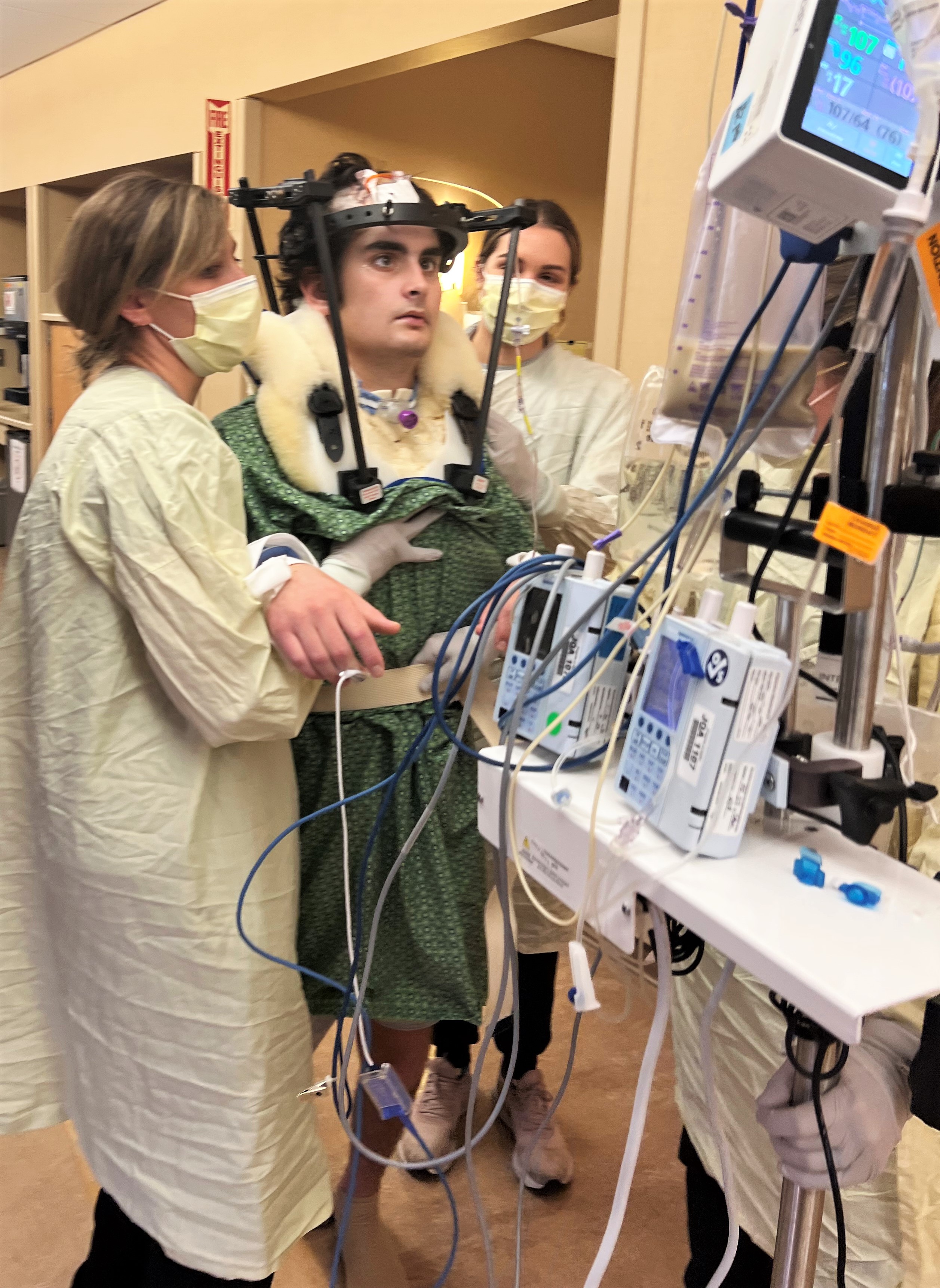
Conrad Blome exceeded all expectations from medical experts by talking and walking just weeks after a serious motorcycle crash left him with critical injuries. Here, he walks with some assistance while still wearing a halo to protect his broken vertebrae and back. Submitted photo
-Renae Blome, Grateful Mother
This Christmas is sure to be a much better one at Jamey and Renae Blome’s house, not because of what’s under the tree, but because of who’s around it.
“We celebrated in the hospital last year,” Renae said. “He was pretty sick Christmas Day. He stopped talking and started to really go downhill really quick.”
“He” is the Blomes’ oldest son, Conrad, who was critically injured in a motorcycle crash outside of Medford on Sept. 10, 2022. He was airlifted to Hennepin County Medical Center, where he spent four months in the hospital with myriad injuries – most significantly, a traumatic brain injury.
But back to Christmas 2022.
Conrad’s sudden decline turned out to be the result of a virus, which his mother described as yet another lesson in how their lives had changed.
“The doctor said that with a brain injury, when Conrad gets sick, he’s going to act differently than you and I,” Renae Blome said.
But what a difference a year makes.
The beginning
The crash happened about 7 p.m., when Conrad veered off the road to avoid a head-on collision with an oncoming car. He was thrown from the motorcycle when it struck a field drive; the bike then landed on him, with his head taking the brunt of the impact.
He wasn’t wearing a helmet.
Though Conrad doesn’t remember the crash, his time in the hospital or his first month back home, he’s heard the story of the heroics it took to save him.
“I can’t believe people saw me,” he said. “People saw the crash happen. I’d like to give her a hug and shake the guy’s hand,” he said of the people first on the scene.
“We do know a couple of the emergency responders and one of the firefighters,” Renae said. “We live in Medford, so people know when something happens.”
What happened was bad: Every lobe of his brain was injured, as was his brain stem. He had skull and facial fractures, as well as a fractured back and neck, but no injury to his spinal cord. He needed a breathing tube and a feeding tube.
The family knew none of that, of course, until they made a frantic drive to Minneapolis.
“Conrad had been flown in and was just getting off the helicopter,” to be taken to the high-level trauma emergency room at HCMC when his parents arrived.
“The neuro-resident told us (the injuries), and I said, ‘Just tell me it’s going to be OK,’ and he never did. He never did,” Renae said.
“They never give you hope, because with brain injuries, they don’t know,” she said. “They would only tell us what they saw: He’s a 21-year-old male that’s strong. That’s who he is. But he was a fighter, and stubborn.”
Five days later, Conrad opened his eyes and squeezed his mother’s hand.
A halo – a rigid brace that keeps the head and neck in place so that bones can heal – was placed a week after the crash.
A week after the halo was on, Conrad was off the ventilator.
A month after his crash, he was speaking through his trach.
In late October, he was walking with assistance.
Along with the ups came plenty of downs, from unexpected brain bleeds to hydrocephalus to agitation and confusion.
It was en route to surgery for the hydrocephalus that Renae saw that neurologist from the day of the crash.
The resident asked if that was indeed Conrad, and if he was talking. Renae answered yes to both questions.
“The neuro-resident looked at me and said, ‘He’ll be just fine, then.’ That was the only sense of hope and encouragement from one of the neuro team that he would be OK,” she said. “A different version of himself, but OK.”
Conrad’s trach was removed two months after the crash; the last tube connecting him to a machine was removed Dec. 19.
After 116 days in the hospital, Conrad went home to Medford on Jan. 4.
The middle
“I think I’m doing better every day, but there’s a long list of things,” Conrad said of his continued recovery.
The last month of his hospitalization, he was moved to a rehab program for brain injuries. His therapists there suggested he go home to continue the work, instead of to another rehab facility.
“Prior to his accident, he would take apart Harley Davidsons and snowmobiles – then put them back together,” Renae said. “He was a jack-of-all-trades; he fixed tractors for the farm, anything.”
Conrad still had periods of confusion at home, though, including not recognizing his beloved hunting partner: Ellie, his chocolate lab.
“We’d take him down to the shop to see if that would trigger some memories,” Renae said. “We’d roll his wheelchair down there, and he’d sit on the snowmobile. It was encouraging for us to see him move.”
She knew things were on the right track when he realized who Ellie was.
“The best thing for brain healing is nature, being outside,” Renae said, “and physical activity.”
When Conrad was in the hospital, his parents weren’t sure what his future looked like, mobility-wise.
“So we sold all the snowmobiles and bought a pontoon, because we knew if he was in a wheelchair … we could get him on a pontoon,” Renae said. “That’s been a joy for me, as his mom, to see him on the water.”
They make the drive to Minneapolis two or three times a week for ongoing neuro rehab. Conrad has some short-term memory issues, still works with speech pathology, and is having orthodontic work done.
“When we had to go back to get cleared from the neurosurgery team, the doctor said, ‘These are remarkable scans. We don’t see any of the shearing of the brain, the brain bleeds – that’s healed,’” Renae said of her son’s medical progress.
She also heard from the head of neurosurgery at HCMC, who told her the same thing.
In fact, Conrad is passing many of the tests his therapists put forth, including balance. The goal is for him “to get back on ladders again, to work with the family company,” Renae said.
His physical successes are a double-edged sword, she said.
“When he does really well, then he can be a little impulsive and do more than he should.”
But she remains grateful for the progress.
“Some of the things he comes up with doing, like fixing something,” she said. “He’s still clicking in there. His brain is really trying to recover.”
The future
“It’s pretty crazy I’ve come this far,” Conrad said. “Now I just want my eye surgery.”
That’s scheduled for this week, with the hope that the muscle realignment will relieve the inward drift of his eyes, another casualty of the crash.
“His vision is pretty poor, and it’s a daily struggle for him,” Renae said. “When you have double-vision, your brain has to work double-time, too.”
Conrad also has severe hearing loss in his left ear but is having good results with a hearing aid. He’d like to have surgery on that, too, but there is no guarantee it will help. All of his inner ear bones were broken in the crash.
But the eye surgery – that could lead to two very important outcomes for Conrad: being able to get his driver’s license and being able to see well enough to work on small engines again.
There’s more.
“Before my accident, I built a fish house, and I usually go out to our lake and ice fish there,” Conrad said. “I like ice fishing a lot. I’ll be able to ride snowmobiles and ice fish.”
His brother still has a snowmobile, and Jamey keeps one for the farm, to check fence lines and other chores.
Now Conrad has one, too. He bought a mountain sled, one that can be used for riding in extra-deep snow or more rugged terrain, “but I need to get my eyes fixed before I ride it.”
And there may be another dog in his life.
The overarching goal is to have Conrad, now 22, live independently, Renae said, “and having a hearing assist dog would be nice, or a service dog for anxiety. Sometimes on the bad days, you need more of a companion than your mom.”
She is on a temporary leave of absence as her son’s personal care assistant.
“Living with a brain injury, every day is different,” both for the patient and for the caregivers, she said.
“We see little glimpses of the old Conrad, but with the brain injury, the experts say you should mourn the old version of your loved one, and embrace the new,” she explained.
Even so, his mother said, Conrad is “still the funny guy; he likes to tease; he loves to give people a hard time and joke around.
“That’s the same, your heart – that doesn’t change. He still loves to give hugs and enjoys talking to people.”
Renae knows, though, that it’s a challenge.
“People with traumatic brain injuries – they call them the walking wounded,” she said.
While Conrad has made great strides in his recovery, “even if someone looks great on the outside, they might be struggling within, and you don’t know that. It doesn’t cost anything to be kind.”
It’s a message that especially resonates this holiday season.
“Christmas comes down to the people you’re with,” she said. “It puts things in perspective. Before the accident, we took life for granted, as many people do. We try to simplify now.
“We don’t need all this stuff; we just need each other.”