


Crew helps hurricane-ravaged Florida
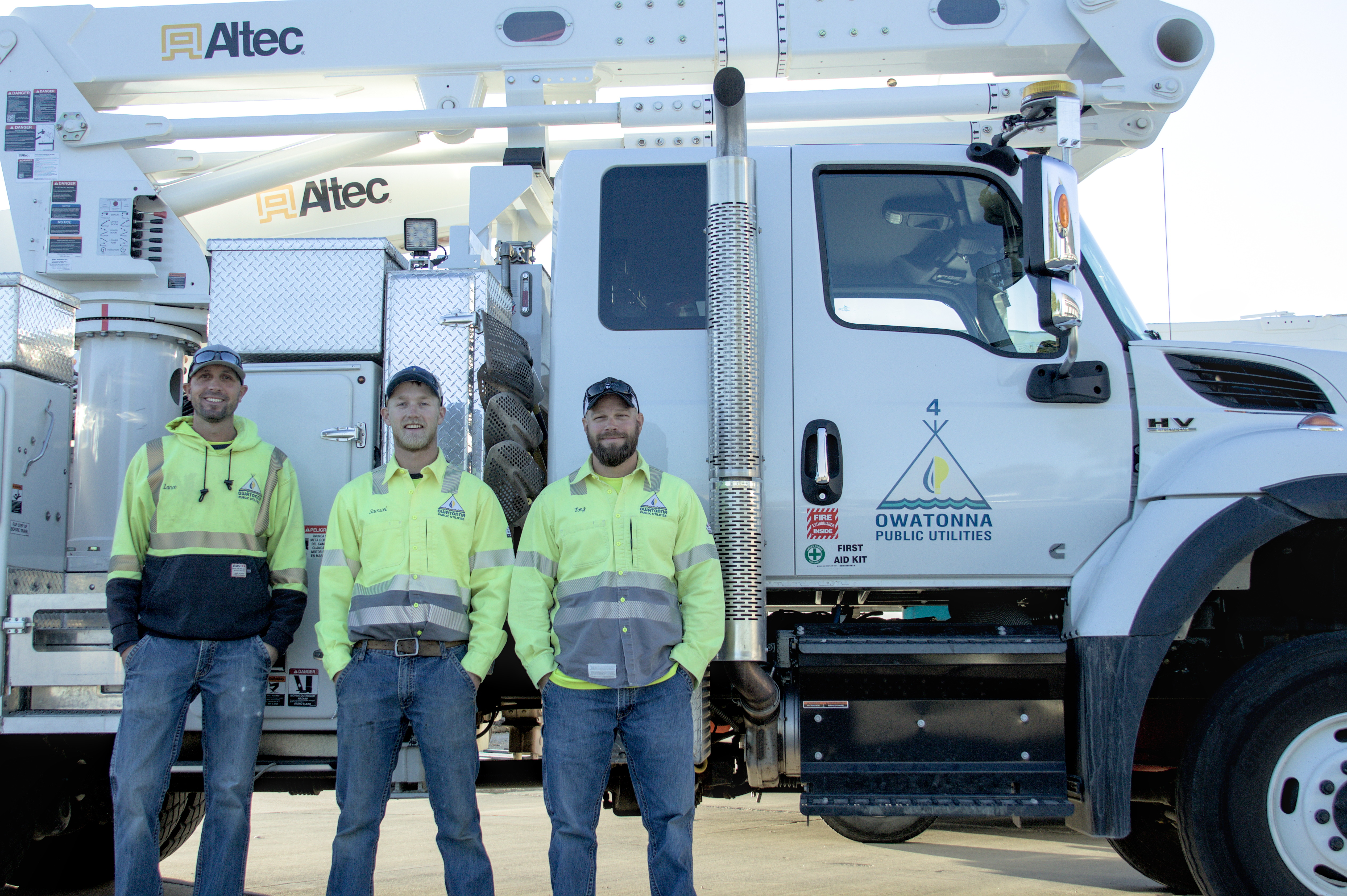
Mutual aid crews left Minnesota last week for Kissimmee, Florida, where they’ll help restore power knocked out by Hurricane Ian. Three Owatonna Public Utilities line workers were part of the convoy that took off Friday from Rochester. Submitted photo
Line workers from Owatonna Public Utilities (OPU) are working to turn the lights back on in Florida, after a deadly tropical cyclone left nearly 2 million customers without power.
Hurricane Ian left behind a path of destruction in the Cayman Islands and Cuba before making its first landfall a week ago on Florida’s southwest coast. State officials said Friday that as many as 21 people may have died in the storm.
Christian Fenstermacher, OPU’s director of engineering and operations, said Tony Hartle, Lance Diderrich, and Samuel Bahl traveled to Rochester on Sept. 28 to meet up with line crews and safety and support staff from 13 other Minnesota communities.
The workers moved 23 vehicles, including bucket trucks, digger derricks, dump trucks, and support pickups to Kissimme, Florida, where they’ll stay for about two weeks.
The mutual aid effort is coordinated by Minnesota Municipal Utilities (MMU), Fenstermacher said. The nonprofit provides a range of services to more than 100 municipal electric and natural gas utilities.
“They coordinate things for us to be a liaison between us and the utility company we are headed down to support,” Fenstermacher said. “They provide a lot of the prep work.”
Owatonna’s utility has two mutual aid agreements, with MMUA and with the American Public Power Association, a national organization. Fenstermacher said Owatonna benefited from the state agreement when tornados knocked out power in 2016.
MMUA will cover the cost of sending the local line crew to Florida and, in turn, recoups those dollars from the Federal Emergency Management Agency (FEMA).
OPU line workers Hartle, Diderrich, and Bahl will help restore power, which will likely involve moving trees and dealing with Florida wildlife. The intense work, Fenstermacher said, continues from sunup to sundown.
While they start out in Kissimmee, the crew may be called to work in other areas as well. After two weeks, if there’s still work remaining, they’ll be flown back, and another local crew will replace them.
“They’re definitely making a huge commitment,” Fenstermacher said. “They like to do this work, but it is exhausting.”