


Danish farmers tour Medford dairy operation
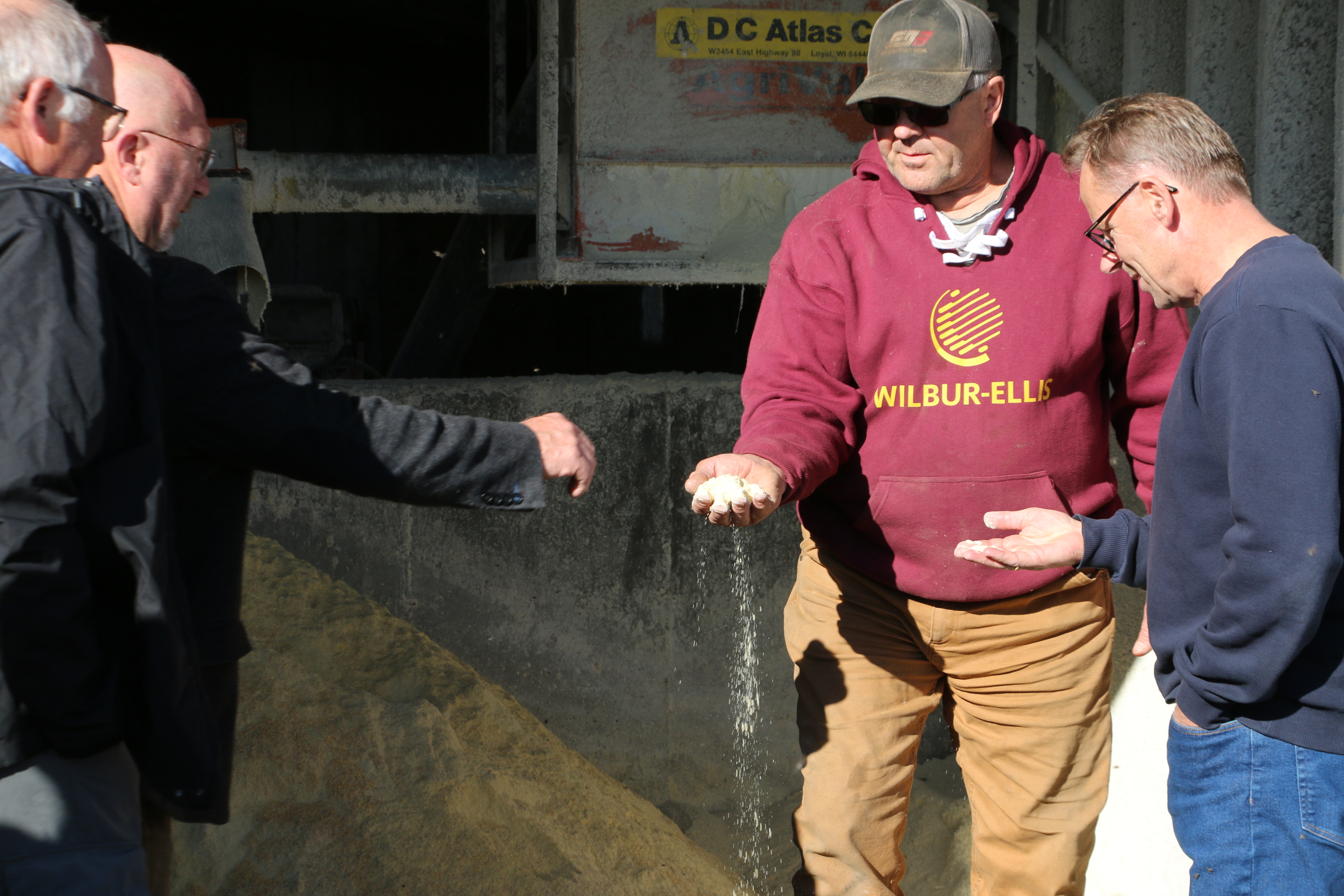
Rick Balzer, second from right, explains to Danish farmers that he grows a dairy-specific corn that is easier for cows to digest. The group toured the Balzer farm last Monday. Staff photo by Joni Hubred
Rick Balzer keeps a guest book for those who tour his Medford dairy farm, and last Monday, a dozen Danish farmers signed it.
He got a call early that morning asking whether he could fill in for a neighbor who wasn’t able to take the group. They’ve been traveling across the U.S. visiting farms, implement manufacturers, and other ag-related businesses, learning about American farming practices.
Their first stop on Oct. 16 was an ethanol plant in Mason City, Iowa. They arrived in Medford around 2:30 p.m.
Balzer said he’s had many people from other countries visit his 500-acre farm, which his father bought in 1949. He took over in 1980 and began welcoming overseas visitors in 1998, with an Italian farmer who owned a small farm and wanted to improve his English.
“We built a shed while he was here,” Balzer said. “It was a fabulous experience.”
These days, though, people are probably more interested in how the Blazers manage their herd of 125 cows.
“We’re pretty unique with the robots,” Balzer said, adding visitors have come from as far away as Guatemala and Japan.
The computerized system has cows with special collars walking onto a platform to be milked by machine. A supply of corn and soybean meal inside it keeps them in place, and the machine reads their collars to record body weight, milk temperature, bloody milk, milk pounds, and the time each teat cup stays on.
Cows are typically milked three times a day, with some going through up to six times, depending on their production level. The two that are milked more produce about 22 gallons a day.
The main advantage to the system is reduced labor, Balzer said, “and not getting injured.”
With the help of tour guide and interpreter Boeji Oesterlund, the Danish farmers learned what goes into the feed for Balzer’s cows–and why, what crops he grows, what role the government plays in farming.
Oesterlund was editor for an agricultural newspaper in Denmark.
“We have taken groups on tours for years,” he said, adding it’s an opportunity to learn and to improve English skills. “It’s nice when it’s a smaller group like this.”