


Finstad on the farm
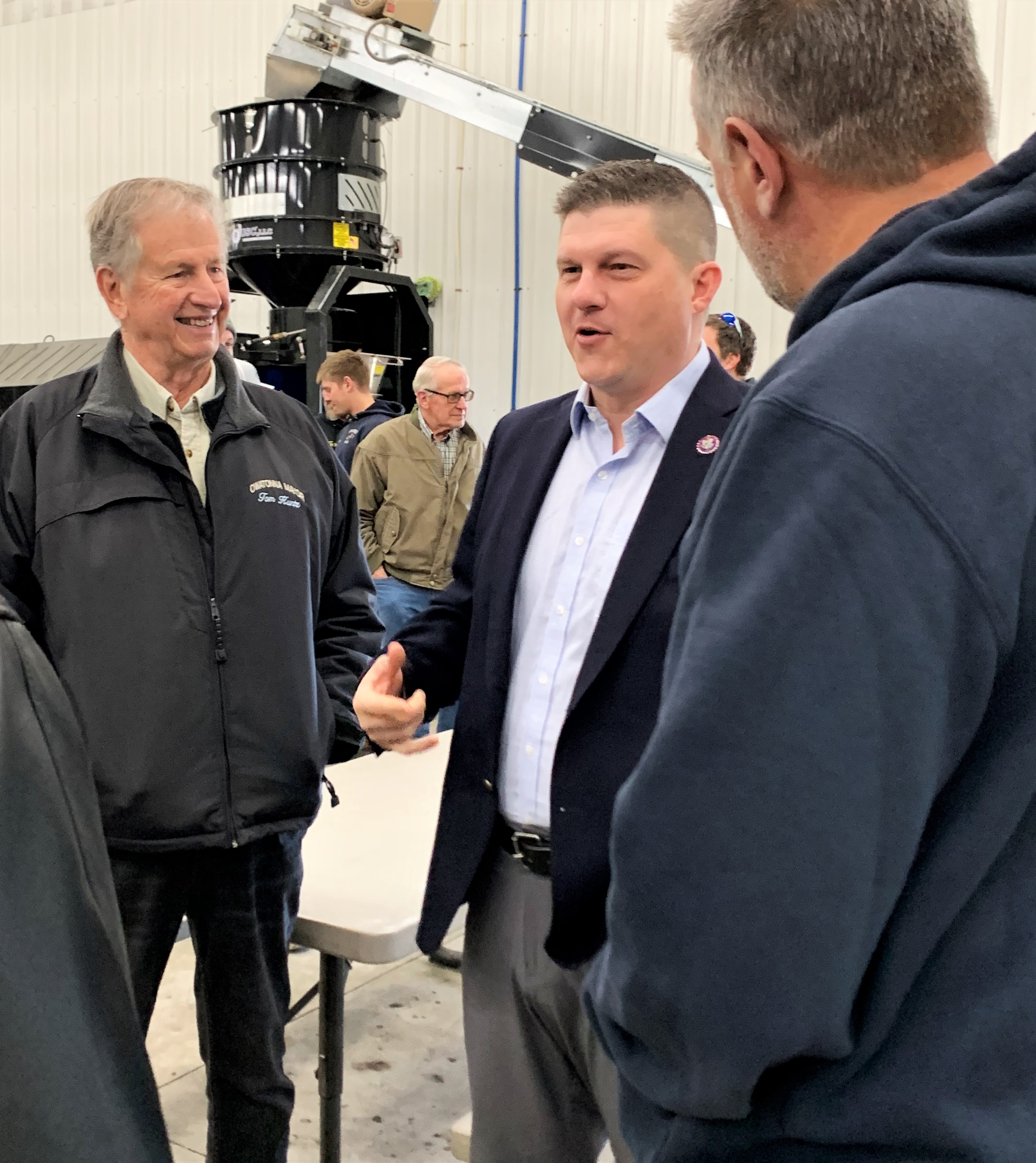
U.S. Rep. Brad Finstad, center, talks with Owatonna Mayor Tom Kuntz, left, and Reid Stransky, right, during the Congressman’s stop at Stransky Farms last week. He addressed multiple issues, including carbon credits, E-15, relations with Russia and China, immigration, and the farm bill. Staff photo by Kay Fate
-Brad Finstad, U.S. Rep
Brad Finstad felt right at home on the Stransky family farm in Steele County – right down to the color of the equipment.
It was clear the U.S. Representative from Minnesota’s 1st Congressional District also felt comfortable speaking candidly with the small group that assembled last week to get their questions answered.
After all, it was just a bunch of farmers talking.
“Right before the election, they started asking what committee I’d like to be on if I won,” Finstad said, “and I told Speaker (Kevin) McCarthy, ‘I will not serve in Congress if I’m not on the ag committee.’ And I was serious.”
Finstad won not only the first election, which filled the remainder of the late Rep. Jim Hagedorn’s term, but the general election in November, defeating former Hormel CEO Jeff Ettinger, of Austin.
Farm bill
That’s how the fourth-generation farmer from the New Ulm area found himself working on the new farm bill – a multi-year law that governs an array of agricultural and food programs.
It’s renewed every five years; without reauthorization, some programs would expire, such as nutrition assistance and farm commodity support programs.
“We’re making sure we’re writing the farm bill for farmers and by farmers,” Finstad said. “For rural America, by rural America – not a bunch of bureaucrats in D.C. telling us how we’re going to farm, or activists from the EPA telling us how we’re going to control our tillage and our drainage, but to truly have regular farmers at the table.”
One of his key priorities, he said, “is that risk management tool: crop insurance. Not too many professions in this world where you can have that insurance on your income, and I want to make sure we have a very strong crop insurance title.”
Finstad also spoke about the conservation title in the bill, addressing the Conservation Reserve Program and others like it.
“We have to maintain that they remain voluntary,” he said, “with more local control.”
Fully 80% of the farm bill is the nutrition title, including SNAP, known colloquially as food assistance or food stamps.
“Why is it in the farm bill?” Finstad said. “Because in Congress, we need 218 votes to pass a bill. So how do I get a representative from Manhattan to vote for a farm bill if they’ve never been on a farm? Quite a bit of their population needs some sort of nutrition help … but along with that, I would say that food security is national security.”
Russia and China
Finstad also serves on the armed services committee, which ties into the ag committee.
“We have to be conscious of the fact that Russia and China are flexing their muscles at us right now,” he said.
When Russia invaded Ukraine 13 months ago, “what did we feel on the farm?” he asked. “We instantly saw costs go up by 400%. I saw it on our farm, I saw it all over southern Minnesota.
“We saw disruption in the energy department,” he continued. “We’re paying more at the pump.”
China has created economic vulnerability in the supply chain, Finstad said, “by deciding not to use our dollar anymore, making it weaker, making us more vulnerable.”
Late last month, China and Brazil struck a deal to make trade and financial transactions directly, instead of first converting their currencies to the U.S. dollar.
Reid Stransky, who with his wife Daria hosted the event, jumped in.
“How worried are you?” he asked Finstad, referring to the possibility of military action.
“I was at the Pentagon a couple of weeks ago,” Finstad said, “and I can tell you, our military is posturing for some sort of event with China, because of the signals China is giving us. So I’m worried; I am worried about it.”
In early February, a Chinese balloon that flew over the United States reportedly managed to gather intelligence from military bases and transmit the date to Beijing before it was shot down, officials said last week.
Foreign markets
The issues with China reach American farms, Finstad said.
“From an agricultural perspective, so much of our exports are tied to that Asian market,” he said, and it’s more than just the sale of grain.
It’s imports, as well.
“If today, China shut down, we’re all going to try to figure out more quickly how to be reliant on America,” he said, citing the production of antibiotics like amoxicillin and computer chips that are crucial for all sorts of technology – including farm machinery.
The CHIPS and Science Act, signed into law by President Joe Biden in August, allocated more than $50 billion to bring semiconductor chip manufacturing to the U.S. – and away from East Asia.
The day before his stop in Steele County, Finstad toured a chip manufacturing plant in New Ulm.
“Some say that we’ve actually been in this conflict with China for 30 years, but we’re just now paying attention to it,” he said, by outsourcing so many things.
Now, though, “there are tons of logistic opportunities; we’ve just got to get better at it.”
Carbon credit
The first issue with carbon credits, Finstad said, is finding a common definition.
Very simply, each carbon credit is a kind of “permit” that represents one ton of carbon dioxide removed from the atmosphere. They’re an antidote for the carbon dioxide and other greenhouse gases that are typically belched out by oil, transportation, energy, and waste management sectors.
Farmers, particularly crop farmers, can potentially produce a significant number of carbon credits with different methods–growing or increasing cover crops, reducing fertilizer application, rotational grazing, reduced or no-till farming, and more.
“One of the things I’ve been talking about, from a farmer’s perspective,” Finstad said, “is let’s treat it like a commodity. Sell them on a commodity exchange: supply and demand. That’s where we need to go, but right now it’s the Wild West.”
The U.S. doesn’t have a national cap and trade program on the credits.
“I say this somewhat tongue-in-cheek,” he said, “but we need some sort of government interference on the front end, just to qualify what a carbon credit is, and if we can all agree on that, then we have something we can trade on the commodity market.”
Taxes and the other ‘C’
Peter Zimmerman, a fifth-generation farmer in Waseca County, told Finstad about a catastrophic fire his family experienced two years ago – and the response from legislators.
Within three days, he’d heard from his state and national representatives, Zimmerman said, as well as from the United States Department of Agriculture, asking how they could help.
“It was a breath of fresh air from what we normally see our government conglomerate do for the farmer,” Zimmerman said.
Now, however, “we’re getting overrun with government requirements on just to clean out a ditch,” he said. “It ends up being a huge cost that’s passed on to the farmers. I’ve seen the government be able to streamline a lot of that – is there any way to bring more common sense into what our bottom line will be?”
Zimmerman was also concerned about “the other threat that starts with a C – California. Everything is going electric – and I’m not anti-electric – but when are they going to say they can’t sell corn in California unless it’s combined with an electric combine?”
The ag committee “can’t give one state so much power over the rest of the country how we produce our goods,” Zimmerman said, calling California “the most dysfunctional state in the country.”
Finstad agreed, telling the group that the committee recognizes the issue, but “is the farm bill the place to do it?”
Instead, he said, “we need to work on exports and diversifying marketing opportunities. We need to have a conversation about interstate commerce, because we laugh, but electric combines might not be that far off.”
In the end, Finstad told Zimmerman, “we fight back with common sense, and be confident that we’re involved in one of the most honorable, long-term professions this country was built on.”
Other topics
Finstad also discussed the increased use of E-15, cryptocurrency, and the best way to educate others about the importance of agriculture.
Owatonna Mayor Tom Kuntz asked the congressman about his bipartisan efforts, saying “party politics are at their worst.”
Not necessarily, Finstad said.
“Senator (Amy) Klobuchar and I get along great,” he said. “We have the same sense of humor – she makes fun of me, and I make fun of her. I’m driven to work with folks that want to get things done. I’ll work with anybody who comes to the table with honesty, integrity, and the best interests of Minnesotans.”
Stransky, the host, asked about immigration and the border with Mexico and got a measured answer.
“We’ve seen two very different ideas on the border,” Finstad said. “President Trump wanted to build a wall, stop the insanity. President Biden says no wall, no border, nothing.
“We’ve seen two different plans, so how about we build a wall – with a door,” he said. “This country was built on immigration; I don’t think any of us would deny it. We need a workforce; but we need to make sure it’s legal, make sure they’re paying taxes and Social Security, make sure they’re part of building the American dream.”
The challenges of paperwork and years of delays “don’t make sense, right? So we need to fix that. We don’t need a lot of bureaucracy – those of us in this room could fix that right now.”
Finstad said he’s been told that in Congress, “you can’t have immigration reform without a border (plan), so they will be linked.”
Bipartisanship
Finstad’s responses carried a theme of “common sense rules” throughout the discussion.
“My conversations with folks on the other side of the aisle have been very fruitful,” he said. “I tell people, I think 80% of Congress understands and agrees that we could fix (things) right now; it’s the 10% on each extreme that are fighting the loudest.
“If we just focus, and really empower the 80% to get it done – and again, (party) politics doesn’t need to be involved at all.”
Both the committees he serves on, Finstad said, display “genuine cooperation, and real work happening.”
The voices
Finstad’s office approached the Stranskys after hearing Reid’s questions at a different event, said Daria Stransky.
“There was a discussion about the Green New Deal, and Reid commented on it; then they asked if we’d be willing to host a stop on his tour,” she said. “We were happy to do it and reached out to our friends and other farmers.”
In addition to farmers, “I had some industry leaders from ethanol, the mayor, the sheriff, an OHS teacher and coach, an industry executive from Viracon,” Reid Stransky said. “I thought we had a broad group of people who could all ask questions, and after listening to them, you heard what the most important topics were on people’s minds.
“It was a great discussion – and nice to have some one-on-one time with a United States Congressman.”