


‘It wasn’t enough’
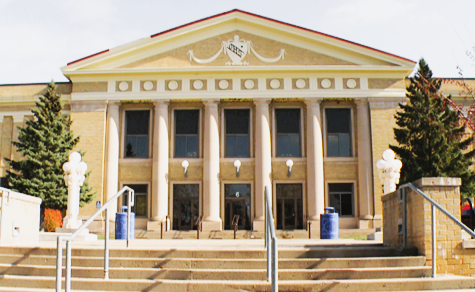
Almost a year to the day that a task force recommended giving a developer more time to refine his proposal for the existing Owatonna High School, the group was back in front of the school board.
A full room listened as members of the task force made their second recommendation – this time to reject the proposal.
“Our recommendation is to stop negotiations with them and proceed with the plans to demolish the school building,” said Pat Heydon, on behalf of the task force.
It’s a big proposal for a big property – and it would carry a big price tag for the developer, Paul Warshauer of Grande Venues/Former Owatonna High School LLC.
The big question, though, is where the money will come from.
The proposal
A new, $126 million high school will open this fall, leaving behind a campus that has spread significantly from the original 1921 structure.
The school district plans to retain ownership of the C plaza, the gymnasium/locker rooms and the VoAg building, using them for district offices, the gymnastics program, maintenance and other support areas.
The hope was to repurpose the remaining areas, including the original 1921 building and auditorium; the G-wing, which houses math, science and industrial tech; the atrium; underground plaza; the lunchroom and all green space.
The proposal from FOHS featured cottages senior housing in the green space, a performing arts center, apartment units in the 1921 building, meeting and convention space, Three Rivers Housing development, and a “social service hub.”
The developer proposed three closing dates for the various parcels, from January through November 2024, for a total purchase price of $15,000.
“There were some overarching concerns about the proposal,” said Superintendent Jeff Elstad, expanding on behalf of the task force.
“As they were walking through that proposal, there were questions about the funding that was available” for what was planned, he said.
There was no assurance that, should the development not happen, there would be funding to demolish the buildings and not pass the costs on to the city or the school district.
There were concerns that a realistic timeline would leave the buildings sitting empty for a number of years, Elstad said, and the “phased” purchase of the property would leave the district unable to proceed with its own project until November 2024. In the meantime, the district would incur the costs of maintaining the buildings.
And finally, he said, “there was concern that once the property was sold, the group could turn around and sell it to somebody else.”
Recent history
The group tasked with overseeing what becomes of those spaces was created in October 2021; about 25 members of the community met monthly and designed a list of criteria that any redevelopment proposal must meet.
As part of the referendum that provided funding toward the construction of the new building, a second question allocated $11 million toward repurposing the existing campus, either through redevelopment or demolition.
Request for preliminary proposals brought forth just one, and in April 2022, the task force recommended the district enter into a development agreement Warshauer.
The task force members “were generally excited at the interest/potential of the proposal, while still having many questions,” they said at the time.
Due to the complexity of the project, Warshauer asked for an additional 180 days to “fully vet possibilities and find partners.”
In November, the proposal was resubmitted; the task force had a list of questions and sought additional information. FOHS LLC provided those answers in February, giving the group about six weeks to consider before making the recommendation to the Owatonna School Board at its work session on Monday.
The criteria
The existing high school sits smack in the middle of an established residential neighborhood, which was the driving force for the criteria any proposal had to meet:
- Project should be financially responsible and consider leveraging a variety of funding types;
- Project needs to benefit the community as a whole
- Project must be beneficial to the surrounding neighborhood in matters such as safety/security, quality of life, property values and more
The concerns
“As a group, we were gung ho when we got that proposal,” said Zach Spinler, a member of the task force.
In the final meeting with FOHS LLC, he said, “it was like somebody just let the air out of a balloon. We wanted it to succeed. We wanted it to happen.”
When April St. Martin was named to the task force, she was very opposed to the demolition of any buildings.
“But really understanding what it would have taken, we just didn’t have the time or the money to put into it,” she said. “We were going to find a way to make it work, and it just couldn’t come together like we had hoped.”
Heydon considered her role not only as a task force member, but as a taxpayer.
“Asking the community to get behind this, we needed a solid plan,” she said. “We needed some good, concrete terms … in the end, there was just too much up in the air for the district to take on, and likewise, the community to be asked to support what really were some unanswered questions.”
The developer wasn’t rushed into it, said Josh Cosens, another task force member.
“We chose to give them a long time to develop their plan; I think they had adequate time to come up with something substantial,” he said. “When they had their proposal to us, it wasn’t enough.”
There were a lot of great ideas, Cosens said, and a lot of good possibilities, “but they had nothing concrete that would prove to us that it was feasible.”
The Owatonna School Board is expected to make its final decision on the proposal at the April 24 meeting. The recommendation includes proceeding with the district’s project of repurposing part of the campus on its own timeline.