


Troubled by war, Klukas finds peace in forgiveness
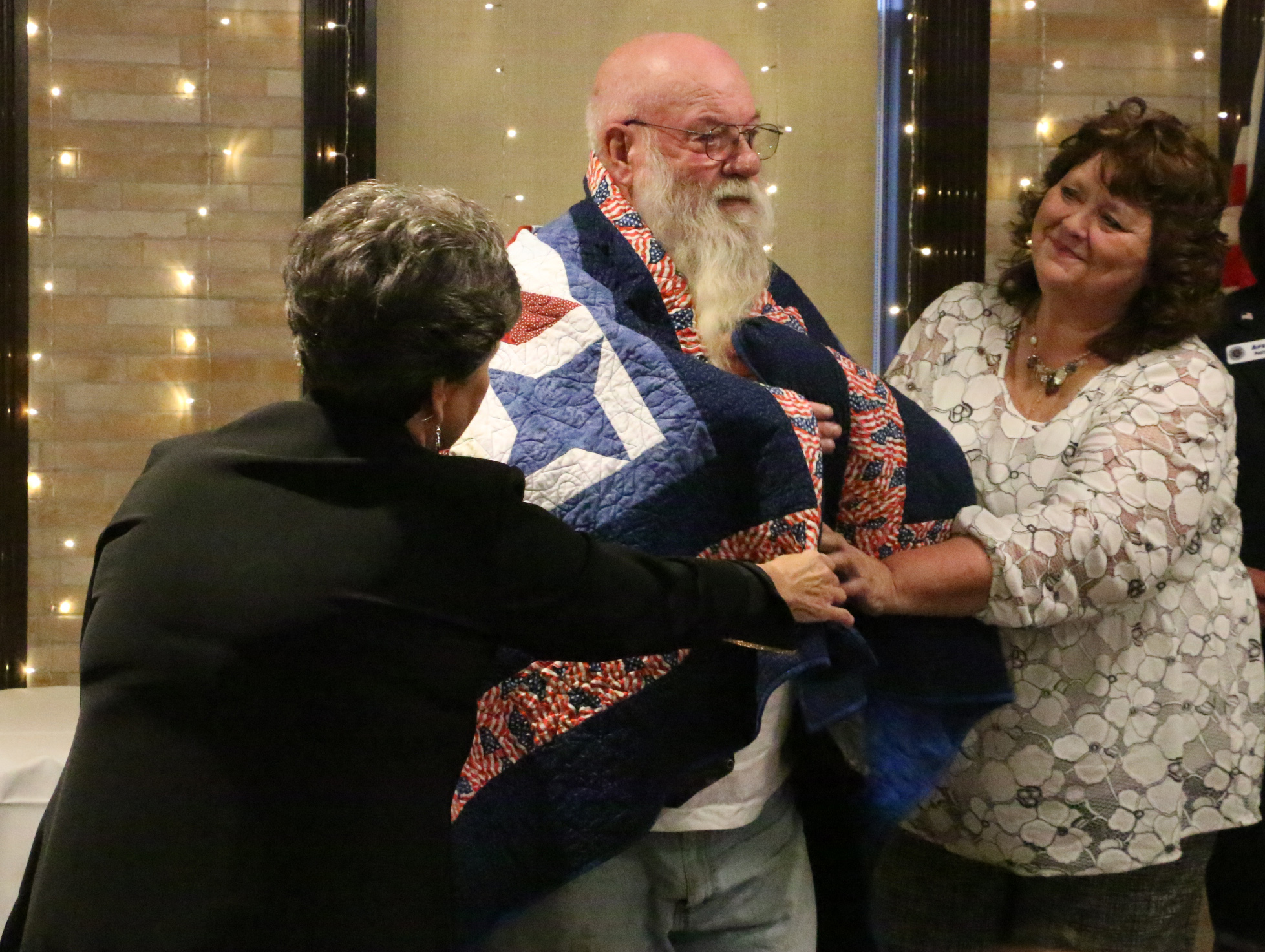
Presenters Pam Mikeworth, left, and Sandra McConn-Halla wrap Vietnam veteran Jim Klukas in his Quilt of Valor during a ceremony held in September at Torey’s in Owatonna. Pictured far right is event emcee April Paxton. Staff photo by Joni Hubred
Jim Klukas grew up in what he calls a “typical family” of the 1950s and 1960s.
His parents farmed near Waseca. Born Catholic, he was an altar boy at Corpus Christi Catholic Church. He graduated from Waseca High School and within a few months, volunteered for the draft.
“My brother (Bob) was running the farm, and he was looking at getting drafted,” the Owatonna resident recalled. “I figured, what the hell.”
He arrived at Fort Campbell, Ky. On Sept. 10, 1968, and from there went to Fort Lewis in Washington for advanced infantry training. He got his orders for Vietnam on February 2.
“I was originally put in a transportation unit, which was pretty fair duty” with regular showers, a mess hall, an enlisted men’s club, he said. “It was bearable.”
After two months, he was sent to the 101st Airborne Division, and “that’s where things kinda went downhill as far as living conditions.” He was spending time in the field, then, with the occasional USO show and cookout to relieve the stress of battle.
Klukas pulled security duty on bridges and worked on Highway 1, a major thoroughfare that connected cities including Da Nang and Hanoi. He walked primitive paths and sometimes trekked for weeks along trails the soldiers cut for themselves to avoid booby traps.
Eight long months later, Klukas’ tour ended. The days before he left Vietnam, he said, were the most stressful. He worried that he would get shot after spending all those months fighting.
“My thoughts were, I just want to go home,” he said. “I remember getting on the plane, and my thoughts were, I am never going back.”
He has had opportunities to return to Vietnam and has never taken them. “Would it help me? Or would it bring things back? I just didn’t want to find out.”
While he didn’t experience the same angry reception some Vietnam vets got when they came home, Klukas said he was “pretty exhausted.” The weather was an adjustment; after spending a year in the hot, humid jungle, he caught a flight to MSP in February, during a blizzard. He took the bus home, where his brother and a neighbor picked him up.
A neighbor got him a job driving a gravel truck, then he delivered cement for a while. Klukas then went to work for National Tree Service in Owatonna. Life after the war “was a challenge. It didn’t seem normal. I had a lot of adjustments to make.”
Crowds bothered him, people gathered in the open. You didn’t do that in Vietnam, he said, “because you were vulnerable. If there was a sniper, they’d shoot for the bigger group.”
“I don’t like a lot of people around me. I know the war is over, but it’s hard to convince the brain.”
Klukas married; he and his wife, Audrey, have been together 48 years. He said even today, some smells and noises trigger memories. He has trouble with the sound of helicopters overhead. But it helps him to understand now why he feels the way he does.
Much of his recovery from his experiences in Vietnam–his homecoming, you might say–has centered around forgiveness. He’d held onto hard feelings for a long time. But an encounter with a local Hmong family helped him over them.
While working the farmers market in Central Park with Audrey, Jim noticed the Hmong selling vegetables nearby.
“I found myself getting upset,” he said. “I decided to move right down next to ‘em and see what happened. Pretty soon, we were saying good morning. Pretty soon, we ewre talking about different things.”
Pang Bang, Klukas learned, was a refugee from Laos. He talked about his journey out of Laos and how he ended up in Owatonna.
“It kind of disarmed me from hating the man because he was Oriental, to looking at it a whole different way,” Klukas said.
Over time, the families grew closer. The Klukas’ grandson played with the Bangs’ grandson. Then one day, Bang’s wife came to the market with an apple pie and invited the Klukas’ to share it with them.
“So here we were, sitting in Central Park, eating apple pie, and I just thought, maybe it’s okay. Maybe the war is over,” Jim Klukas said.
The connection didn’t stop there, either. At one market, Bang handed Klukas an envelope that contained an invitation to his daughter’s wedding reception, which the Klukas’ decided to attend. While he admits to feeling anxious around so many people who were Asian, Jim enjoyed the experience and learning about Hmong customs.
He knows, though, that forgiveness is a long road and not everyone will take it.
Klukas’ long-time friend, local artist Al Smith, was planning a presentation on forgiveness at his church. He shared breakfast at Hy-Vee with Klukas and a friend Ricky Schultz, who has since passed away.
Schultz had served two tours in Vietnam; his brother was killed in action.
“The conversation came up that Al was gonna do this presentation at church on forgiveness,” Klukas said. “I asked Ricky… maybe we should go, and maybe we should forgive the Vietnamese, and he said, absolutely not. He got pretty upset and left.”
“I got thinking, you know, never’s a long time,” he said. “I think a lot of recovery over Vietnam is based on forgiving. Forgiving yourself. Forgiving the Vietnamese, the government, the voters that elected the officials that sent you over there. The government for sticking their nose into it. That’s kind of a big pill to swallow.”
If he’d just sat and stewed on the other side of Central Park, Klukas said, his emotions could have gotten overwhelming, and the situation might have ended badly.
“That whole deal with Pang and forgiveness, that was probably a Godsend, to really say it’s over. I think there is a God, and I think God puts people in your life.”