


‘We’ve heard the people’
Owatonna city leaders spent about an hour explaining an unexpected change to a contentious public safety facility proposal before unanimously approving a different location for a new police station.
“Why now? It really just comes back to, we’ve heard the people,” said City Administrator Jenna Tuma.
“They said, ‘we support it, we just don’t want it at West Hills.’ This is our opportunity to show the people that we were listening,” she said.
The background
In March 2026, the Owatonna City Council unanimously approved issuing up to $65 million via Capital Improvement Plan (CIP) general obligation bonds for new public safety facilities.
The proposal involved moving the police department into temporary quarters at a former school district building on Bridge Street; the existing police station would be razed.
In its place, the city would build a 42,000-square-foot fire station, providing more bays for equipment, dedicated storage and decontamination areas, more room for training and potential future growth.
The original plan also included building a new 60,000-square-foot police station on the West Hills Campus, a city-owned 40-acre parcel of land that was once home to the State Public School for Dependent and Neglected Children. The entire campus is on the National Register of Historic Places.
City residents voiced opposition to building anything on the grounds they consider not only historically significant, but sacred.
The cost was also a sticking point.
The response
Reaction to the tax impact and initial site plans prompted a group of residents to pursue a little-known state statute called the “reverse referendum” law.
It allows taxpayers to challenge large municipal borrowing projects and force a ballot vote if they gather enough signatures within 30 days of the project's public hearing.
The group collected more than 2,400 valid signatures, well above the required legal threshold. In April 2026, the city recognized the petition as legally sufficient, which halted the direct issuance of the bonds and sent the decision to the Nov. 3 ballot.
Still, residents continued to fill the public comment portion of city council meetings for weeks, asking for more input in the project.
The change
On Sept. 11, and after zero public discussion, the city issued a news release: Staff had a recommendation for a new site for the police station.
Tuma said leaders revisited three other locations that were originally rejected as options for the proposed police station: the former Owatonna High School site; the Pillsbury College campus; and the former Cemstone site on North Street.
The OHS site had two potential spots, neither with enough property to locate the new police station. It is landlocked, with no room to expand in the surrounding residential neighborhoods. Because of that, the conversations didn’t even reach the topic of cost.
The Pillsbury College campus is centrally located and large enough for a joint fire and police facility, with room left over for a potential community center. That all came at a price, though: $15 million for the entire campus, $6-7 million for a parcel, which “quickly put us out over our price point,” said Troy Klecker, community development director.
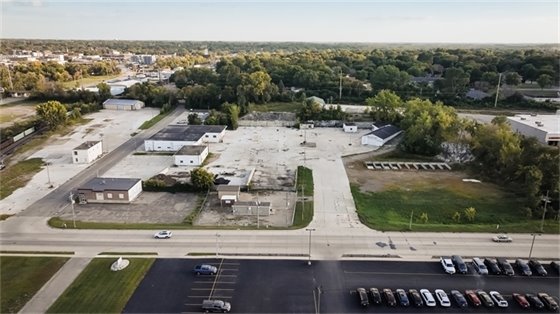
That left the former Cemstone site on North Street, just east of Cash Wise Foods. Though it isn’t centrally located enough for the fire department’s response time requirements, it ticked many of the boxes for a police station.
It is large enough, city-owned and might be a tough sell to a private buyer for redevelopment, Klecker said, because of “large elevation changes from the top of the railroad tracks, lots of concrete, and several older buildings” to be razed.
In July, the city bought adjoining property in the northwest corner of the site, which was privately owned. That purchase allows access to the site from North Street.
When soil borings returned results similar to the readings at West Hills, it was time to move, said Tuma.
Other concerns
The site was widely believed to be in a flood plain, which is technically true, Klecker said, but the flood maps created by FEMA “are not 100% accurate.”
While the maps may indicate flooding potential, it’s the elevation that is the determining factor, he said.
“If it’s in the flood plain, that doesn’t mean you absolutely cannot do anything with it,” Klecker explained. “It means there are more regulations when it comes to building there.”
A 100-year flood level is 1,133 feet above sea level; Cemstone sits at 1,136 feet above sea level, which “far exceeds any requirements any agency would require for that.”
Still, Klecker said, the city would follow 100-year flood level requirements.
The largest flood of record in Owatonna, which occurred in 2010, did not reach the property.
Railroad tracks run east and west on the south side of the property, as well as north and south on the east side. The railroad doesn’t prohibit building near the tracks, though it has an identified “hazard zone” for derailments.
Positioning the new station closer to North Street would remove it from that zone, Klecker said, and would also allow for the hill on the south side of the property to be graded down, improving site lines from the building.
“It can work,” he said.
Due diligence
Tuma said leaders heard through “several platforms of our engagement” that people were “concerned with the location … at West Hills. It just wasn’t right,” despite support for the project.
“As new properties would come (up), I made the commitment to continue to pursue a better location,” she said. “As part of the due diligence, we continue to engage the public … I just want to make sure that the public knows that we heard them.”
Making the location change via resolution, Tuma said, is the city’s attempt to regain the trust of the public.
“I think this shows that there’s more teeth in it – more credibility that this is the official site,” per a vote by the council. The other suggestions, she said, “were just staff recommendations.”
Council President Kevin Raney doubled down on the location.
“So long as I am on Council, I will not support coming back to West Hills,” he said. “We move forward tonight and I’m not looking back.”
Former Police Chief Jeff Mundale, who retired three days later, was asked to weigh in.
“I think there’s probably not one perfect, ideal site. We’re doing the best to try to stay centrally located, but we do believe that yes, this is a very viable, suitable site – and law enforcement supports it,” he said.
No other changes
The bond request remains at up to $65 million.
“It’ll be a little tighter, no doubt, but it’s still within that” bond amount request, Tuma said.
The resolution – amended by Councilor Brent Svenby to definitively rule out building at West Hills – also authorized staff to move forward with the design of a new station, “otherwise we’ll be substantially behind,” Tuma said.
“Everyone can still vote on this resolution,” said council member Dan Boeke. “My thought is, why not remove the contentious portion of this referendum, if the West Hills are so contentious? We’ve got 2,700-some people that said, ‘we don’t want it’ … so let’s bring the resolution down to one thing: Money and taxes.
“If it turns out that the resolution fails, at least we’ll know why it failed,” he said, “and then we can scramble from there.”
Boeke admitted he believed the measure would have failed without the location change.
“Whatever way the vote goes this fall, I hope it’s by a big margin,” he said. “Then we can all get together and get going.”