


‘Don’t treat your soil like dirt’
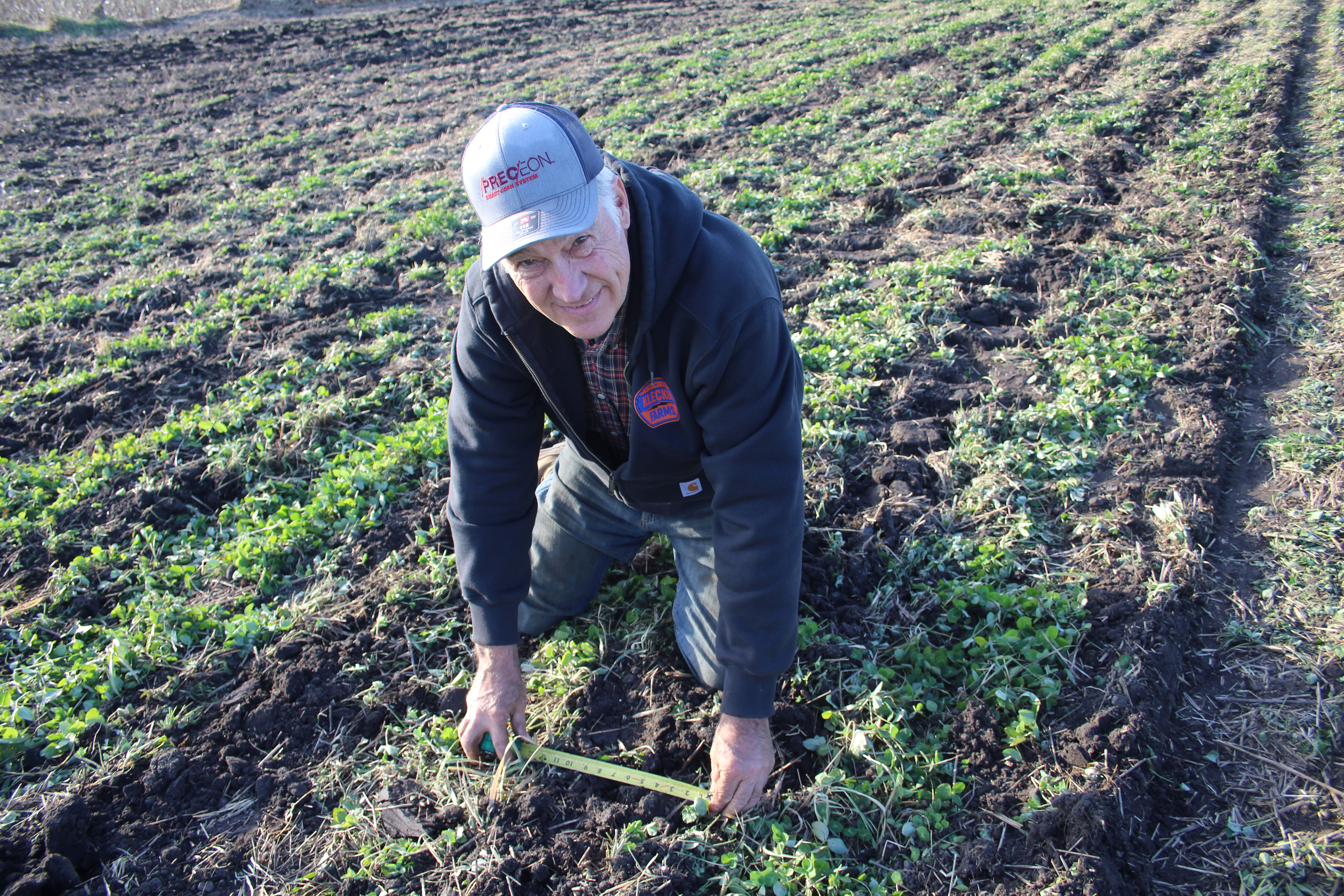
Dean Jirousek measures the space that is cleared during the strip till process. Staff photo by Karen M. Jorgensen
-Dean Jirousek, Ellendale Area Farmer
Agriculture changes often come slowly, but some local farmers say they are seeing a small but growing movement to change how crops are grown, more specifically, how the soil is managed.
Strip tillage is a conservation practice that tills only a narrow band of soil where the seeds are planted while leaving the soil between the rows undisturbed. Area farmers who practice it say it helps control erosion and the soil retains more moisture. It also improves the basic health of the soil.
Dean Jirousek, who farms a couple hundred acres near Ellendale, uses the method and says he is happy with the results.
“A farmer’s biggest asset is the soil,” he said. “I like to take care of my soil.”
Conventional farming, he said, tills the entire field. No till farming on the other hand is where the seeds are planted without any plowing or mechanical turning of the soil. Strip till is a method between the two.
He says that after several years he now is at 95% strip tilling and five percent no till. He has seen improvements in soil health over those years, and the soil is more “loamy” and is not as compacted.
Strip tilling, he said, is more efficient and allows him to prepare a field in a shorter period of time.
The equipment used, he said, is different from that in conventional tilling. A row of sharp wheels called coulters, are spaced so they can clear the residue out of an area of about 10 inches wide and several inches deep with the residue pushed to the space between the rows. The equipment also includes a large tank that contains the fertilizer which is applied at the same time the row is cleared.
This, he said, means both actions can take place simultaneously and the fall field work can be done faster and in one-pass. It puts the fertilizer right where the plant is going to use it. He said he can get 20 or 21 acres an hour finished even with the smaller 30-ft. wide equipment.
Shane Wagner, who has a larger farming operation on the eastern side of the county near Claremont also has been strip tilling for several years and he agrees with Jirousek about the benefits regarding soil health and the time-saving aspect.
“It means less hours on the tractor,” he said. He said he can cover about 30 acres an hour.
Both men also say they practice other conservation methods including the use of cover crops. Rye, radish, kale, turnips and oats are common cover crops used, they said.
“I like my fields green,” Jirousek said of the cover crops.
Both Jirousek and Wagner also said they practice crop rotation between corn and soybeans with oats added in as a third crop in the cycle.
Wagner said the practice builds improved soil structure over a couple years, and he also has seen other changes. He said he has seen more pheasants and fawns since he changed his tilling practices and also an increase in partridges.
One added benefit, both said, is that when the weather is very windy and there is little or no snow covering the field, it prevents erosion and sending the soil to the neighbor’s field or yard.
Both also agreed on a practical advantage to strip tilling, the financial savings. All farmers are affected by rising diesel and fertilizer prices and making only one pass through a field reduces diesel costs and the improved soil health means buying less fertilizer. Both also said their crop yields have actually increased as soil health improves.
Since the equipment needed is different from conventional tillage, machinery costs are a factor. Wagner said there are two options available to the farmer changing to strip tilling. One can buy their own equipment, which can be expensive, or hire someone who does custom tilling.
Jirousek said that he has chosen to go the custom route with his smaller acreage while Wagner has chosen to have his own equipment.
Although more area farmers are expressing an interest in the strip trilling movement, it has been slow.
“Strip tilling is relatively new in the ag world,” Jirousek said.
“It’s slowly catching on,” Wagner said. “The younger generation is pushing a bit more.”
For Jirousek the main reason remains soil health.
“Don’t treat your soil like dirt,” he said.