


DWI training certification had LEC buzzing
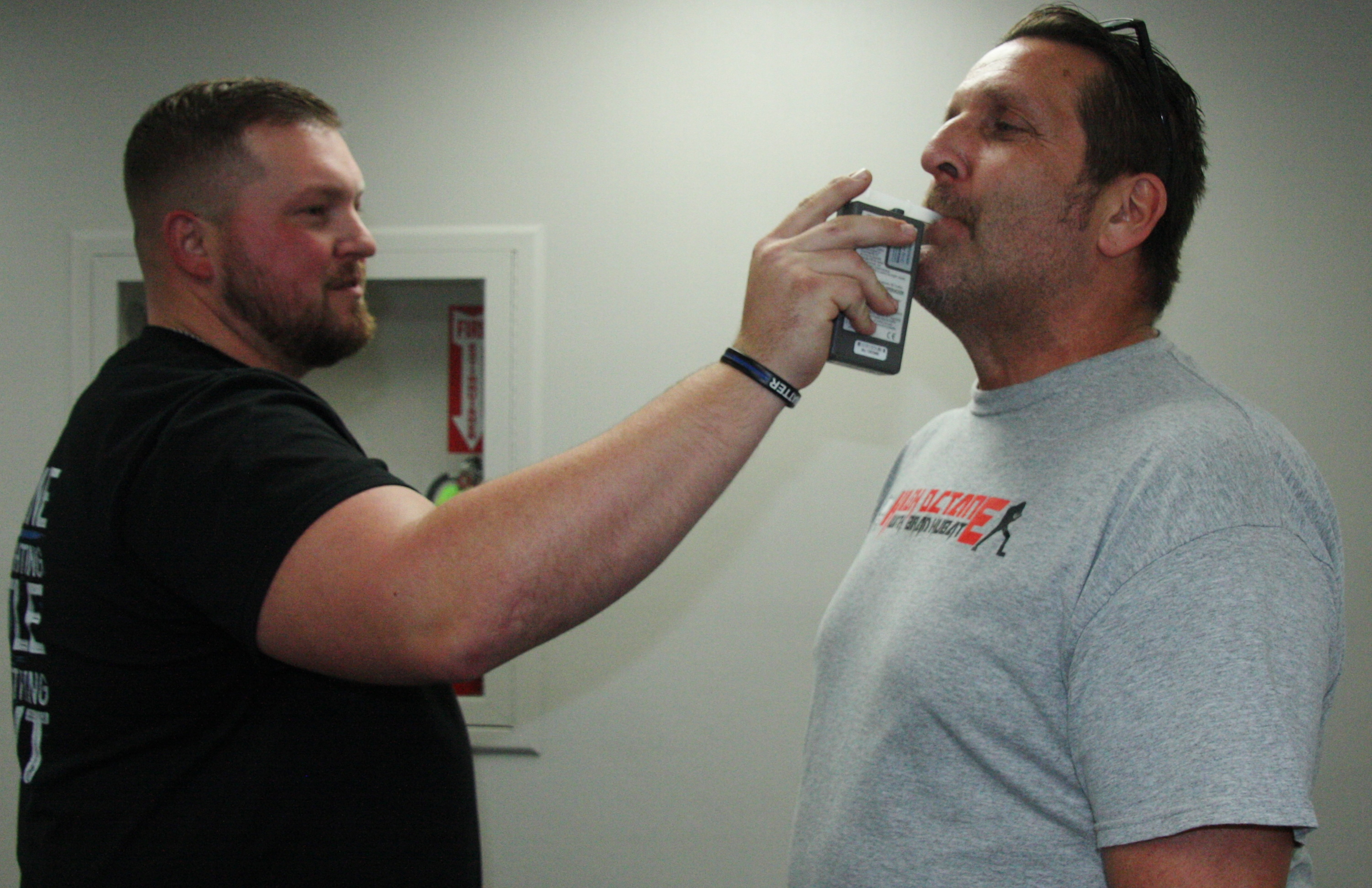
Patrol Officer Tony Malepsy, right, administers a breathalyzer test to Brad Kubat during a DWI training certification for Owatonna Police. Kubat was one of four people who drank hard liquor for two hours, then performed field sobriety tests. Malepsy was the instructor for the classroom portion of the training. Staff photo by Kay Fate
At 3 p.m. on a recent weekday, Brad Kubat inhaled deeply and blew into a breathalyzer.
There was good news and bad news.
The bad news: The test indicated Kubat’s blood alcohol concentration was .088 – over the legal limit to drive.
The good news: He hadn’t been driving. He’d been a test subject.
It was for the Owatonna Police Department’s DWI training, part of the requirement to take advantage of grant money from the state’s Toward Zero Deaths campaign.
Seven officers spent much of the day in the classroom, taught by Patrol Officer Tony Malepsy.
“Our officers here come with a lot of experience,” he said, “and it’s a good refresher for senior officers, fine-tuning their skills.”
While the officers were in the classroom, four local residents were sitting in the lower level of the Law Enforcement Center, drinking alcohol on an empty stomach.
They were offered whiskey, vodka, or rum, said Capt. Josh Sorensen, and could change the mixer, but not the alcohol.
“It’s a controlled environment,” he said. “They’re allowed a set amount of alcohol, set by their body weight.”
Beer was not offered; the nature of the testing required the alcohol be concentrated in order to get the desired impairment level.
After two hours of drinking, Malepsy had each DWI subject do an initial breathalyzer test. Kubat’s registered .109, well over the legal limit.
When the officers finished in the classroom, their test – and the sobriety tests – began.
The goal, Malepsy said, “is for officers’ observations to identify impairment. It’s a lot harder to find somebody that’s impaired at .08 than somebody that’s at .16.”
There are three phases of a DWI stop, he said, beginning with probable cause to stop the vehicle. That could be a traffic infraction, a burned-out headlight or taillight, inconsistent speed – or other issues.
Phase 2, Malepsy said, is “do I have enough clues of impairment to ask the driver to exit the vehicle: odor, bloodshot eyes, slurred speech…”
The first two phases were covered in the classroom. The final phase – field sobriety tests – required help from Kubat and the other drinkers.
Neither the drinkers nor the officers had seen the initial PBT results collected by Malepsy.
“So from the (field sobriety) tests, they’re going to tell me if they’d arrest (the drinker), if they wouldn’t arrest, and what they believe the blood alcohol concentration is,” he said.
The TZD coursework teaches the officers how to estimate the level of impairment by the number of “clues,” or mistakes, made during any of the three standardized tests used on people suspected of driving under the influence.
The validated tests are the walk-and-turn – better known as walking the line, heel-to-toe; the one-leg stand; and the horizontal gaze nystagmus, which is what officers are assessing when the drivers follow a light from side to side without moving their head.
HGN is the involuntary jerking of the eye when it moves to the periphery; alcohol use exaggerates the twitching.
Malepsy demonstrated on Kubat, who had been drinking whiskey: “One mixed drink, the rest on the rocks,” he said. “I’m a farm kid, what can I say?”
Malepsy had plenty to say: “He had six clues on horizontal gaze nystagmus, showing he’s over a .08. If there are four clues, there’s an 80% chance they’re over the legal limit.”
Kubat didn’t do much better on the other two tests – and Malepsy was correct. Kubat’s final breathalyzer, just minutes later, was .088%.
“I feel more than buzzed,” he said. “I mean, I’m pretty coherent, but of course, my profession is … talking.”
Kubat is a local radio personality on KOWZ-FM and KRUE Country.
The science behind the absorption of alcohol and the rate at which it burns off also held true.
“He’s about exactly where he should be,” Malepsy said of Kubat’s two PBT readings.
While there was plenty of laughing and good-natured ribbing, the overall message was clear to everyone involved.
“It was a lot of fun, and informative, but at the end of the day, my perspective on this is, don’t drink and drive; you’re going to get nailed,” Kubat said.
The drinkers were all provided a ride home.
“They’re having a good time, and the officers want to learn. We want to keep it positive,” Malepsy said.
“They all live in this community – they want everybody to be safe.”