‘I just assumed they were going to be good’
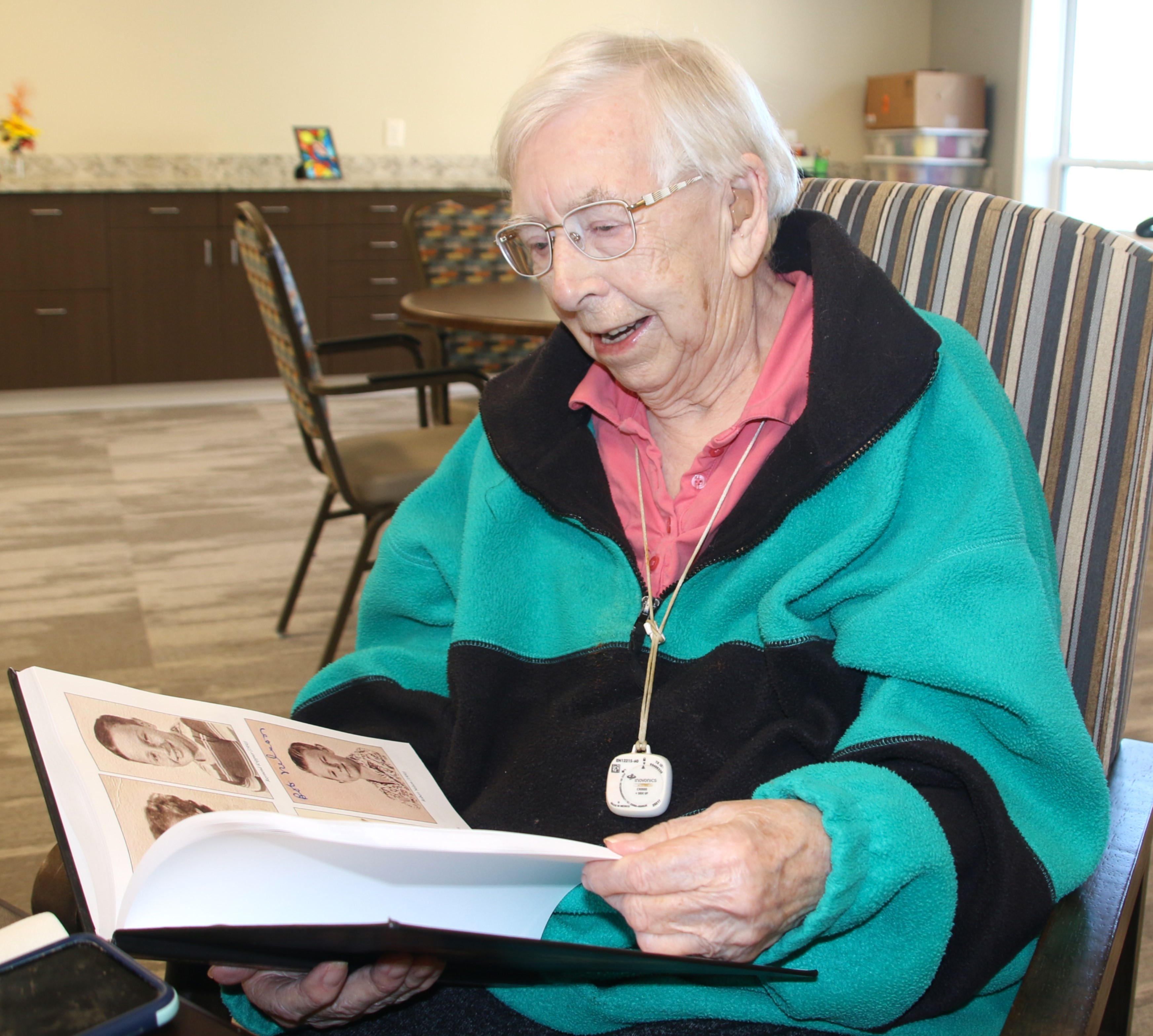
Esther Kruger Buscho, 98, flips through a book written by one of her former students, Ron Eustice. He was a first-grader during her first year at District 78-92 School in Deerfield Township, in Steele County. She left after getting married in the middle of her second year at the district; Eustice went on to graduate from Owatonna High School.
-Esther Kruger Busho, Former Deerfield School Teacher
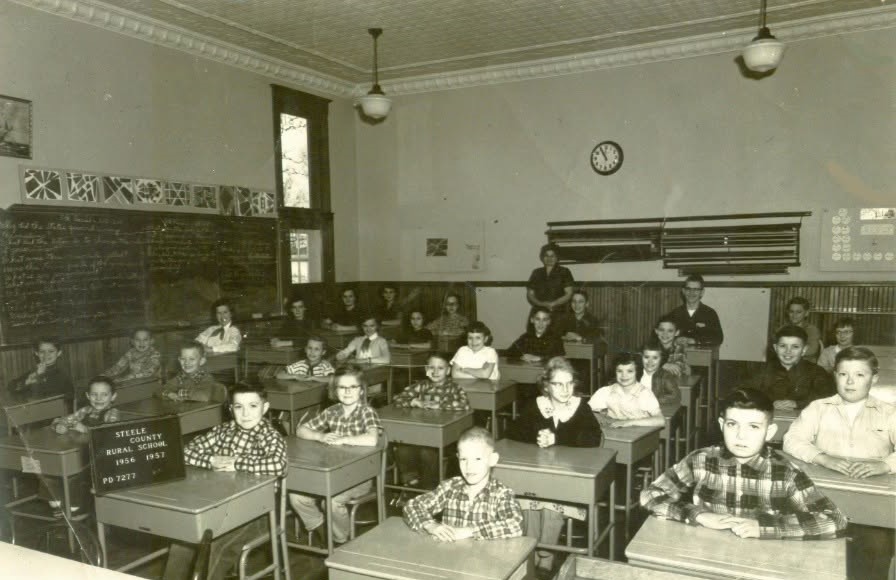
One teacher. One room. Eight grades. Seventeen students.
That all adds up to Ron Eustice’s experience on his first day of first grade at District 78-92 school in Deerfield Township.
The students, all farm kids, lived on the western edge of Steele County or the eastern side of Waseca County – hence, the hyphenated district name.
Eustice was 5 years old; he attended the one-room school through eighth grade, then completed his education at Owatonna High School.
“I was fortunate to have earned an excellent elementary education and, in my opinion, was well-prepared for high school,” he said.
The teacher
Eustice was greeted on that September day in 1951 by Esther Kruger, a fourth-year teacher who was just 23.
Kruger grew up on a farm south of Blooming Prairie – and also attended a one-room country school through eighth grade. She then attended Blooming Prairie High School, where she graduated as valedictorian of the Class of 1946.
She enrolled in the Austin Normal School, affiliated with Austin Junior College, and earned a teaching certificate from the one-year program.
“Miss Hazel Murray was our instructor,” said Esther Kruger Buscho, now 98.
“There were 16 girls, and Miss Murray was very strict,” Buscho said. “The first day, she lined us up against the wall and checked the length of our skirts. And she taught arithmetic to us from an eighth-grade arithmetic book, the same one that we would be teaching from when we graduated and started teaching.”
Of the 16 students, “two of us passed the first test when we finished the book,” Buscho said. “The rest had to stay after school hours and go through that book again.”
She shook her head.
“They had just graduated from high school themselves,” and presumably had to pass eighth-grade math, Buscho said, but they “absolutely struggled a little bit themselves.”
Her first teaching assignment was at a rural school near Hollandale, in Freeborn County.
She was there just a year when school board members from the Red Oak Grove school between Blooming Prairie and Austin came calling.
They needed a teacher, and offered her a $100-per-month raise, which was a huge salary bump; Buscho took the job.
“They hired her because they wanted someone firm,” said her daughter, Fae Holin.
Naughty kids?
“It was different,” Buscho said, “but I wouldn’t say naughty. I never had any problem with disobedience or anything. I never had any discipline trouble, even after I heard that I was taking over this disobedient school. It’s something I never did have in all my teaching.”
She didn’t do or say anything special on the first day of school at Red Oak Grove, “but it would be possible that I had a reputation, because I lived close to there, and I had taught Sunday school (at Red Oak Grove Church) right across the road.”
They weren’t even her former Sunday school students, Buscho said.
“I just assumed they were going to be good; I was teaching them, and they had to do it,” she said.
“I give young kids credit,” said Eustice, her former student. “I think they sense real fast whether or not they can push this teacher. Esther immediately gave the message, and she didn’t have to say a word. You get the message real quickly that this lady is not a pushover.”
Buscho taught there for a year, but didn’t feel the community support for the little school that she had felt at her first school.
A friend of hers, also a teacher, had relatives that lived in Deerfield Township; the school there was looking for a new teacher.
The friend, Buscho said, “knew a family that would be willing to take me as a boarder, so I could live with them and they were close enough to the school that I could walk.”
That was the Ebeling family, whose house was a quarter-mile from District 78-92; their farm also supplied the water for the school, carried there by the students.
District 78-92
There was no running water at the Deerfield school, meaning there were no indoor bathrooms. Many one-room schoolhouses had outhouses until the late 1950s, some until the early 1960s.
Buscho spent just two years there, but remembers most of the students fondly. She and Eustice frequently interrupted themselves to talk about the families who attended the school and lived in the township.
They spoke of Lyle Nelson, a classmate of Eustice, who was killed in a car crash in 1953. His death left Eustice as the only child in his grade until he was a sixth-grader and Donald Redman moved to the area.
They also talked about members of the Bennet, Kath, Krippner and Schlossin families, revisiting who has died and who remains in the area.
Class sizes throughout the years, Eustice said, ranged from 17 to 27 in the eight grades.
The natural consequence, Buscho said, was that the little kids were able to pick up things the older students were learning. When it was the younger students’ lesson time, the older kids worked independently in workbooks.
Eustice, as the only student in his grade, often turned to the set of World Book Encyclopedias when his schoolwork was complete.
The Weekly Reader taught him current events, further sparking his love of school.
“I wanted to learn,” Eustice said. “I knew I was there to learn, and I quickly realized that this is where it had to happen … The only place I was going to get that training was in that one-room country school.”
It was pivotal enough in his life to prompt a book: Deerfield Days: A One-Room School at the Center of a Farm Community was released last month.
He went on to earn a degree in agricultural journalism from the University of Minnesota, has written 49 other books and traveled to 100 countries around the world.
Eustice is working on two more books: Country Schools of Steele County and Owatonna: Butter Capital of the World.
All of his experiences, he said, “began at this one-room country school.”
Community
“Before I was there, (the farm community) wasn’t doing those things at the school,” Buscho told Eustice. “But as soon as I kind of pushed things along, people were glad to come to the school in the evening for (social events). I think we even put on a play.”
“We had Christmas programs,” he said, “and this is very important, because the Christmas program was where we came together. We began to plan it basically right after Thanksgiving. They set up a stage – I mean, it was major.”
When the students returned to school the Monday after Thanksgiving, “there was a platform, there were curtains and we started practicing our ‘pieces’ for the next three weeks,” Eustice said. “This was a big deal, because this was a way for the teacher to show off how smart their kids were.”
It was also a way for the neighbors – most of whom were separated by at least a quarter-mile – to get to know each other.
“You had a neighborhood that started out being all German, all Protestant,” Eustice said. “There were no Catholics in the community until we got there. So you had Methodists that went to (church in) Blooming Grove and all the Lutherans went to (church in) Meriden. We were the only Catholics, and we went to Corpus Christi in Deerfield.”
Everybody went different ways to their respective churches, “and all of a sudden, you have this Christmas program, and everybody came together, you know?” Eustice asked.
“We say the same prayers, we have the same stories … and everybody in the neighborhood was invited,” he said. “They didn’t have to have kids in school.”
School’s out
A couple of things happened during the 1951-52 school year:
The Ebelings, who boarded the young teacher at their home, bought the Pratt store and moved there.
It turned out to be fortuitous timing; that was also the year Esther Kruger met a young bachelor farmer named Vernon Buscho at a card party – one of many social activities held at the schoolhouse.
The two married in 1952.
“I distinctly remember when you got married,” Eustice told Buscho. “I asked her, after that, if I could just call her Esther – because that was a major thing, and she was no longer ‘Miss Kruger.’
“She doesn’t remember that,” he said, “and she just chuckled when it happened, but I was so embarrassed because then I realized it was not appropriate for me to call my teacher by her first name. In those days, it was expected – though not in all cases – that single women were the teachers.”
It held true in Buscho’s case. After that school year ended, she settled into the role of wife, mother and farming partner to Vernon.
The couple had five children, raising crops and livestock at a series of farms across southeast Minnesota before settling down outside of Faribault. The farm remains in the family.
And Buscho kept herself connected to education, encouraging Vernon to take Extension classes in agriculture, teaching her own children to read and working as a substitute in elementary schools.
“I learned about spraying crops,” she said. “That was not Vernon’s department; it made him nervous.”
So Esther did – what else? – the math required in determining the amount of chemicals to use per field.
“That part was easy,” she said, “so I finally just started doing all the spraying the rest of our farming life.”
“Not just spraying,” Holin said, “but mixing it up and deciding what to use, buying the chemicals… The salesmen would say, ‘where’s Vernon?’ and she’d send them down to Dad, and Dad would say, ‘well, I don’t do it – my wife does. Go back and talk to her.’”
Vernon Buscho was 92 when he died in 2021. Esther moved off the farm to an assisted living facility three months ago.
She and Eustice reconnected last year, 74 years after they first met.
“She remembered me, and she remembered my mother,” he said. “It was especially nice, because I was one of 17 little kids, you know?
“And she remembers every one of them.”