


‘Rose was a mission’
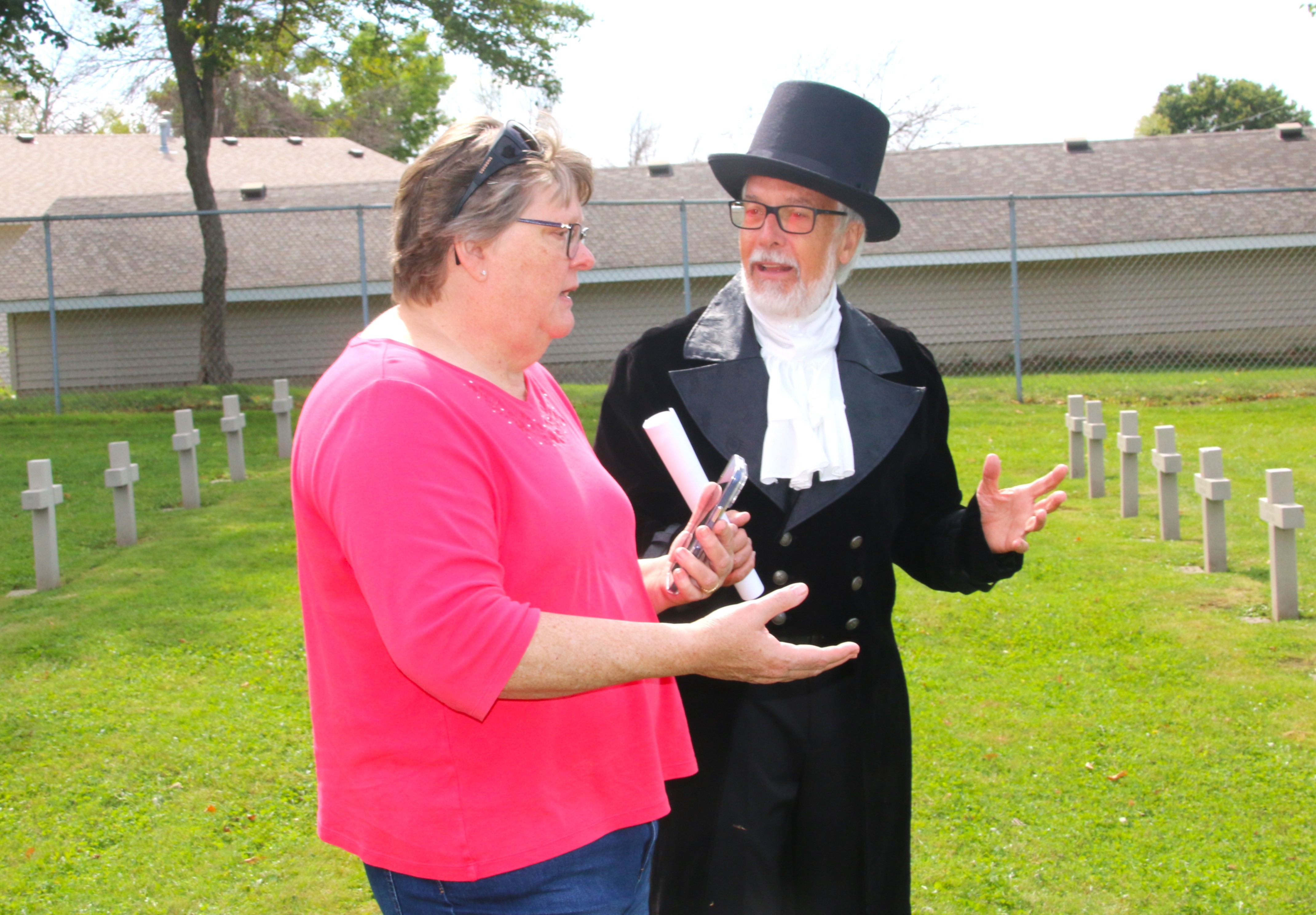
Tim Shea and Cheryl Pfeifer discuss the short, unhappy life of Rose Steele, who was orphaned at the age of 9, then sent to the State Public School for Dependent & Neglected Children in Owatonna. Shea has done research on many of the 198 children buried on the grounds, cleaning and correcting errors on the stones that mark their graves. Staff photo by Kay Fate
Cheryl Pfeifer strode toward the cemetery at West Hills Campus in Owatonna with a purpose – and one question:
“Who’s responsible for bringing Rose Larson back to Steele?”
“I am,” said Tim Shea, as he adjusted his black morning coat.
“Thank you,” Pfeifer said, growing emotional. She spoke of research she had done on the little girl who was one of more than 10,000 children to pass through the Minnesota State Public School for Dependent and Neglected Children in Owatonna.
But mostly, she was there to thank Shea, an Eden Prairie resident who, while on a day trip with his partner Linda Donadei in 2023, stumbled across the neglected, crumbling cemetery holding the remains of 198 students who died at the school.
Donadie “voluntold” Shea he would be the one to bring dignity back to the children, and he set to work scrubbing and readjusting head stones, correcting spelling errors on the markers and identifying the little ones who were previously identified only by their case number.
It became his mission.
“I called it the Lazarus project at first,” Shea said, “because we’re bringing them back; these children need to be respected, because they had no life of their own. There are 198 stories here.”
He never knows how far the ripple effects of his work will reach, so exchanges like the one he had Saturday at the annual fall celebration on the grounds of the former state school are always a welcome surprise.
Finding Rose
Pfeifer’s foray into the story of Rose Larson – the original name on her marker in the cemetery – came via an old sign at an auction.
It read: H.C. Steele, sheep shearer.
The Ellendale man who bought the sign wanted to know more about it, so Pfeifer offered to do some digging.
She learned H.C. Steele was Hember Steele, who was famous in his own right. He and wife Ruth built what is believed to be Ellendale’s first gas station – which later became more commonly known as Gus’ Station.
The station was restored and moved to the grounds of the Steele County Historical Society, where it is a part of the Village of Yesteryear.
Hember’s story led Pfeifer to Rose; the two were half-siblings, sharing a father; Hember was 14 years older and out of the house by the time their father died in 1909, leaving Rose and her brother Frank to be raised by their mother Julia.
A year later, Julia Steele married Theodore Larson. Less than two years after that, she died of tuberculosis.
Larson was left with Rose and Frank, who were just 9 and 11, respectively. He had not formally adopted them – and in fact, didn’t know what to do with them, so he turned them over to probate court, which sent them to the State Public School in Owatonna.
They were admitted as Rose Larson and Frank Larson in August 2013.
School records indicate Rose had hyperkyphosis, noted in her admission sheet by the words: “Rose is a hunchback.”
She was sent to St. Paul for orthopedic treatments, primitive at best, which provided temporary relief.
Rose was diagnosed with pneumonia about a year after arriving at the state school; she died about six weeks later.
Drawing again from school records, Theodore Larson was “advised” of her death, “but could do nothing for her and requested that she be buried at the school cemetery.”
So she was – as Rose Larson.
Return to Steele
Hers was one of the stories Shea traced back to its beginnings, and after researching adoption records at the Minnesota Historical Society’s Gale Family Library, he arrived at the same conclusion as Pfeifer.
“I’m glad I did what my gut said: These kids were not adopted, they were taken out with the trash – and he gets immortalized,” he said of Larson’s decision to surrender the orphans.
“You’ve got to come back and see little Rose,” Shea told Pfeifer as they stood at the cemetery gate.
“I want to see her new stone,” Pfeifer said. “Did you put a nameplate on there that says Steele? Because I was going to keep after it until it (said) Steele.”
She grew emotional again as she viewed the little cross with Rose’s birth name.
“This touches my heart,” Pfeifer said. “I’m so glad. Rose was a mission, and he took care of her.”
Work continues
Rose’s marker wasn’t the only one with inaccurate information, though admittedly, most of the misspelled names are likely the result of human error or handwritten orphanage documents that were difficult to read.
The very nature of the children’s lives lends itself to the fact that there were few family members around to make sure everything was correct.
“We have changed or updated about 13 names,” Shea said. “Another one over here we changed: Willie Towne. Problem was, Willie didn’t have a willy; it was Millie,” he laughed, “so we changed that to Millie Towne.”
Pfeifer appreciates the dedication to accuracy, citing her own family genealogy work.
“Just this morning, I took pictures from my husband’s side back to family members” for identification, she said, before memories fade entirely.
Shea is able to access documents not only about the former students, but of employees, as well.
That has come in handy as he tries to unravel the mystery of a marker that reads only “Baby.”
Using the dates on the markers on either side of the grave, it’s suspected Baby died in February 1916. Shea believes Baby was the son of a nurse who worked at the school at the time, but the child was not technically a ward of the orphanage.
“So we’re still investigating,” Shea said.
Children Remembered
Saturday’s 12th annual event also featured a presentation by Joyce Steen, of Kansas, whose father grew up at the State School.
She later learned he had a younger brother, who is one of the 198 children buried on the grounds.
There were also tours of the Orphanage Museum, Boys’ Cottage 11 and the 1914 gymnasium; a performance by folk duo Curtis and Loretta; State School character reenactors on the grounds; oral histories from State Schoolers and their descendants; a scavenger hunt; genealogy assistance and more.
Donations were accepted for The Children Remembered – Orphanage Legacy Fund.
It provides funding and serves as a foundation for operation of some of the facilities; preserves historic records and provides tours and educational opportunities for the community, visitors and family members of those orphaned and remembered at the facility.
All of it, Pfeifer said, puts the West Hills campus into perspective.
“This is a special place,” she said. “This is sacred.”